Cookie Policy: This site uses cookies to improve your experience. You can find out more about our use of cookies in our Privacy Policy. By continuing to browse this site you agree to our use of cookies.

AdipoGen Life Sciences
TNF-α, Soluble (human) (rec.)
As low as
95
CHF
CHF 95.00
In stock
Only %1 left
AG-40B-0006-C01010 µgCHF 95.00
AG-40B-0006-C05050 µgCHF 215.00
AG-40B-0006-30503 x 50 µgCHF 430.00


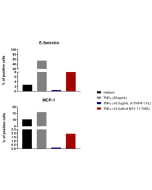
Figure 1: TNF-α, Soluble (human) (rec.)(AG-40B-0074) induces NF-κB dependent genes. Methods: Endothelial cells (HUVEC) are incubated for 1h in the presence of BAY 11-7082 (AG-CR1-0013) and then treated with TNFα (20ng/ml) (red bar) or incubated with TNFα (20ng/ml) (in the presence or absence of TNF-R1 (human):Fc (human) (rec.) (0.5µg/ml) (blue and gray bar, respectively). TNFα-induced genes expression such as E-Selectin or MCP-1 are tested by flow cytometry. Picture courtesy of Giulia Vanoni (Dr. Camilla Jandus Lab, University of Lausanne).
Specifications / Handling
| Product Details | |
|---|---|
| Synonyms | Tumor Necrosis Factor Ligand Superfamily Member 2; Cachectin |
| Product Type | Protein |
| Properties | |
| Source/Host | E. coli |
| Sequence |
A FLAG®-tag is fused at the N-terminus of human TNF-α (aa 85-233). |
| Crossreactivity |
Human Mouse |
| Specificity |
Binds to human and mouse TNF-R1. |
| Biological Activity |
Induces cell death at a concentration range of 0.01-10ng/ml (ED50= 0.05ng/ml or 2 x 10E7 Units/mg; WEHI 164 cells). |
| MW | ~17kDa (SDS-PAGE) |
| Purity | ≥95% (SDS-PAGE) |
| Endotoxin Content | <0.01EU/µg purified protein (LAL test; Lonza). |
| Concentration |
10 µg size: 0.1 mg/ml after reconstitution. 50 µg size: 1 mg/ml after reconstitution. |
| Reconstitution |
10 µg size: Reconstitute with 100 µl sterile water. 50 µg size: Reconstitute with 50 µl sterile water. PBS containing at least 0.1% BSA should be used for further dilutions. |
| Formulation | Lyophilized. Contains PBS. |
| Other Product Data |
UniProt link P01375: TNF-α (human) (precursor) FLAG is a registered trademark of Sigma-Aldrich Co. |
| Shipping and Handling | |
| Shipping | BLUE ICE |
| Short Term Storage | +4°C |
| Long Term Storage | -20°C |
| Handling Advice |
After reconstitution, prepare aliquots and store at -20°C. Avoid freeze/thaw cycles. Centrifuge lyophilized vial before opening and reconstitution. PBS containing at least 0.1% BSA should be used for further dilutions. |
| Use/Stability |
Stable for at least 6 months after receipt when stored at -20°C. Working aliquots are stable for up to 3 months when stored at -20°C. |
| Documents | |
| Safety Data Sheet |
 Download PDF Download PDF |
| Product Specification Sheet | |
| Datasheet |
Download PDF |
Scientific Background Information
Product Description
Tumor necrosis factor (TNF, cachexin or cachectin and formerly known as tumor necrosis factor-α) is a cytokine involved in systemic inflammation and is a member of a group of cytokines that stimulate the acute phase reaction. The receptor TNF-R1 is activated by both the membrane-bound and soluble trimeric forms of TNF-α, whereas the receptor TNF-R2 only responds to the membrane-bound form of TNF-α (MultimericTNF-α (Prod. No. AG-40B-0019). Since the MultimericTNF-α mimics the membrane-bound form (forms oligomers higher than trimer), it is the only TNF-α protein that can activate the TNF-R2. For TNF-R1 activation, either "normal" TNF-α or MultimericTNF-α can be used.
Product-specific References
- CXCL-8/IL8 Produced by Diffuse Large B-cell Lymphomas Recruits Neutrophils Expressing a Proliferation-Inducing Ligand APRIL: B. Manfroi, et al.; Cancer Res. 77, 1097 (2017)
- Harnessing Selectivity and Sensitivity in Electronic Biosensing: A Novel Lab-on-Chip Multigate Organic Transistor: V. Parkula, et al.; Anal. Chem. 92, 9330 (2020)
- Targeting adrenergic receptors to mitigate invariant natural killer T cells-induced acute liver injury: MB. Gonzatti, et al.; iScience 26, 107947 (2023)
Related Products
-
 TNF-R1 (human):Fc (human) (rec.) AG-40B-0074
 -
 TNF Ligands Enhancer AG-35B-0001