Cookie Policy: This site uses cookies to improve your experience. You can find out more about our use of cookies in our Privacy Policy. By continuing to browse this site you agree to our use of cookies.

Netrin-1 – Guidance Cue, Stem Cell Regulator & Emerging Cancer Target
Netrin-1 (NTN1) is a secreted laminin-related protein originally identified as a key guidance cue controlling axon migration during nervous system development. It signals through several receptors, including DCC, UNC5 family members (UNC5A-D) and Neogenin-1 (NEO1), and regulates diverse biological processes ranging from cell migration and survival to stem cell maintenance, inflammation and cancer. The biological outcome of Netrin-1 signaling is highly context-dependent and is determined in part by receptor expression. DCC and UNC5 proteins function as dependence receptors: in the presence of Netrin-1 they can promote cell survival and other cellular responses, whereas in the absence of ligand they can initiate pro-apoptotic signaling. Beyond its classical role in neuronal guidance, Netrin-1 has emerged as an important regulator of pluripotent and hematopoietic stem cells and as an increasingly important research target in cancer biology and epithelial-to-mesenchymal transition (EMT).
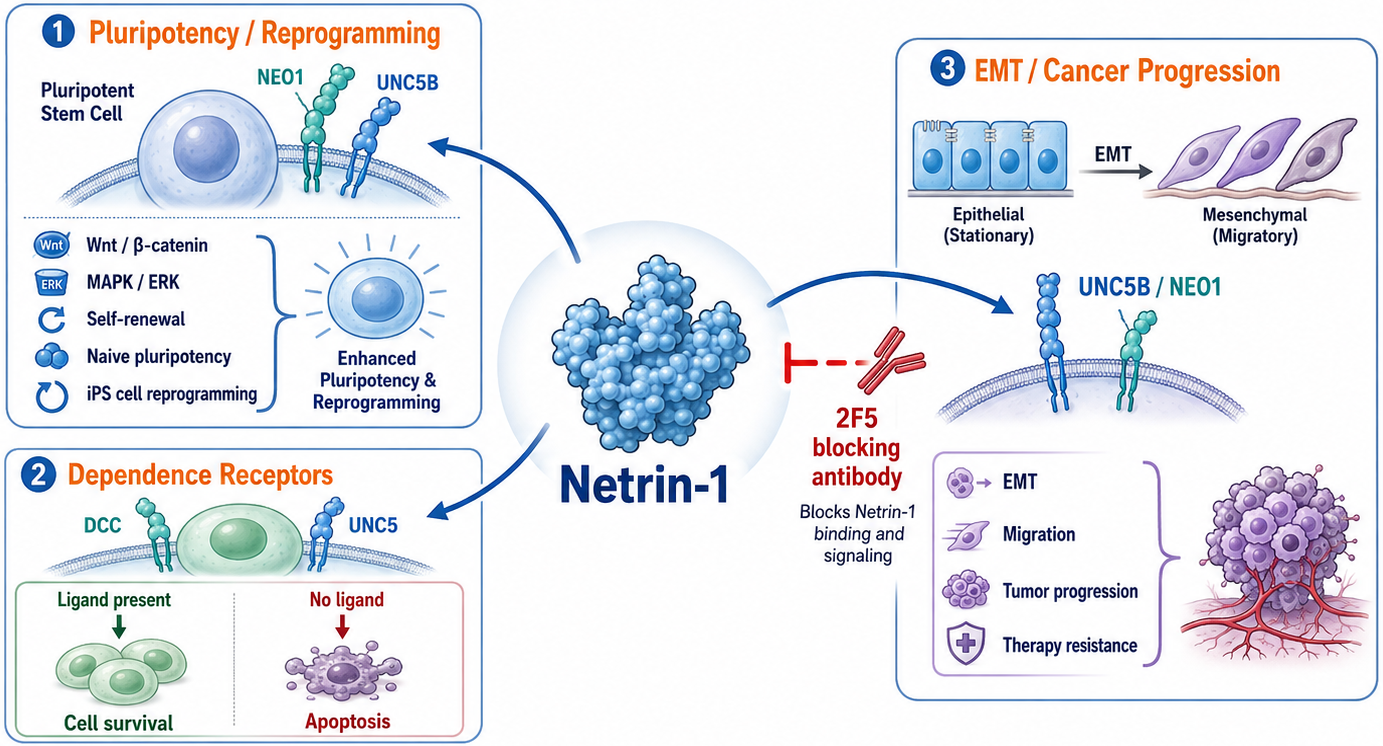
Figure: Netrin-1 signaling pathways.
Netrin-1 in Stem Cell Reprogramming & Pluripotency
Netrin-1 was identified as a soluble regulator of somatic cell reprogramming and pluripotency. A landmark study published in Nature Communications demonstrated that addition of recombinant Netrin-1 significantly increased reprogramming efficiency in several experimental systems. Recombinant Netrin-1 increased iPS cell generation approximately 8-fold in mouse fibroblasts, 4-fold in mouse intestinal epithelial cells and 15-fold in human fibroblasts. Importantly, the recombinant Netrin-1 used in these experiments was obtained from AdipoGen Life Sciences (Prod. No. AG-40B-0075). Subsequent research further established Netrin-1 as a regulator of the pluripotent state. Netrin-1 signaling through NEO1 and UNC5B coordinates Wnt and MAPK signaling and promotes naïve pluripotency. Mechanistically, Netrin-1 activates FAK, leading to inhibition of GSK3α/β and stabilization of β-catenin, while simultaneously reducing ERK1/2 activity. In mouse embryonic stem cells, recombinant Netrin-1 can support self-renewal together with LIF. These findings position Netrin-1 not as an additional classical Yamanaka reprogramming factor, but rather as a soluble regulator of reprogramming efficiency, pluripotency and stem cell survival.
Key Functions in Pluripotent Stem Cells
- Enhances somatic cell reprogramming efficiency
- Supports pluripotent stem cell survival
- Promotes naïve pluripotency and self-renewal
- Regulates Wnt/β-catenin and MAPK/ERK signaling
- Signals through NEO1, UNC5B and DCC depending on cellular context
Netrin-1 in Hematopoietic Stem Cell Quiescence & Self-Renewal
The role of Netrin-1 in stem cell biology extends beyond pluripotent stem cells. Niche-derived Netrin-1 has been identified as an important regulator of hematopoietic stem cell (HSC) dormancy. Netrin-1 produced by the bone marrow vascular niche signals through Neogenin-1 (NEO1) on HSCs and promotes their quiescence and long-term self-renewal. Loss of Netrin-1 from the bone marrow niche reduces HSC quiescence and self-renewal, whereas increased Netrin-1 expression promotes HSC dormancy. Age-associated reduction of niche-derived Netrin-1 has also been linked to declining HSC function. The Netrin-1–NEO1 axis therefore represents an emerging signaling pathway connecting the stem cell niche with maintenance of stem cell function.
Netrin-1, Dependence Receptors & Cancer
Netrin-1 has an important role in cancer biology through its interactions with dependence receptors such as DCC and UNC5 family members. When Netrin-1 is available, signaling through these receptors can favor cell survival, migration and other cellular responses. In the absence of ligand, unbound dependence receptors can instead activate apoptosis. Cancer cells can exploit this mechanism by increasing Netrin-1 expression or altering dependence-receptor signaling, thereby escaping receptor-mediated apoptosis. More recent work has expanded the role of Netrin-1 beyond cell survival. Netrin-1 has been implicated in regulation of epithelial-to-mesenchymal transition (EMT), metastatic progression and resistance to anticancer treatment.
Pharmacological blockade of Netrin-1 has been shown to:
- Promote tumor cell death in selected experimental models
- Inhibit progression toward mesenchymal tumor-cell states
- Reduce metastatic features
- Increase sensitivity to chemotherapy in preclinical models
- Show clinical activity in early-stage studies with Netrin-1-targeting antibodies
Netrin-1 is now being investigated as a clinical-stage oncology target, further emphasizing the importance of the Netrin-1/dependence-receptor pathway for cancer research.
Literature References:
-
Netrin-1 regulates somatic cell reprogramming and pluripotency maintenance: D. Ozmadenci, et al.; Nat. Commun. 6, 7398 (2015)
-
Revisiting Netrin-1: One Who Guides (Axons): N.P. Boyer & S.L. Gupton; Front. Cell Neurosci. 12, 221 (2018)
-
Netrin-1 promotes naive pluripotency through Neo1 and Unc5b co-regulation of Wnt and MAPK signalling: A. Huyghe, et al.; Nat. Cell Biol. 22, 389 (2020)
-
Netrin-1 in Glioblastoma Neovascularization: The New Partner in Crime? X. Vasquez, et al.; Int. J. Mol. Sci. 22, 8248 (2021)
-
Niche derived netrin-1 regulates hematopoietic stem cell dormancy via its receptor neogenin-1: S. Renders, et al.; Nat. Commun. 12, 608 (2021)
-
UNC5 dependence receptor family in human cancer: A controllable double-edged sword: Y. Zhu, et al.; Cancer Lett. 516, 28 (2021)
-
Netrin-1: A Modulator of Macrophage Driven Acute and Chronic Inflammation: L. Ziegon & M. Schlegel; Int. J. Mol. Sci. 23, 275 (2021)
-
Netrin-1: An emerging player in inflammatory diseases: X. Xia, et al.; Cytokine Growth Factor Rev. 64, 46 (2022)
-
Pharmacological targeting of netrin-1 inhibits EMT in cancer: J. Lengrand, et al.; Nature 620, 402 (2023)
-
Netrin-1 blockade inhibits tumour growth and EMT features in endometrial cancer: P.A. Cassier, et al.; Nature 620, 409 (2023)
-
Netrin1 blockade alleviates resistance to chemotherapy in pancreatic cancer: G. Roth, et al.; Nature 654, 798 (2026)
Biologically Active Recombinant Netrin-1 Proteins for Stem Cell and Signaling Research
Netrin-1 (human): Fc (human) (rec.)
AG-40B-0075 (10 µg, 3 x 10 µg; 100 µg sizes & Bulk from Stock)
AdipoGen Life Sciences offers biologically active recombinant human Netrin-1 produced in HEK 293 cells. The Netrin-1 protein binds human, mouse and rat UNC5B and has demonstrated biological activity in functional assays, including DCC-dependent ERK1/2 signaling, axonal outgrowth and stem cell reprogramming. AdipoGen Life Sciences' recombinant Netrin-1 (#AG-40B-0075) was used in the original study demonstrating that soluble recombinant Netrin-1 enhances mouse and human iPS cell generation.
Key Features
-
Biologically active recombinant human Netrin-1
-
HEK 293 cell expression
-
Binds human, mouse and rat UNC5B
-
Functional in stem cell reprogramming and receptor-signaling assays
-
Induces axonal outgrowth
-
≥95% purity
-
Low endotoxin (<0.1 EU/µg)
-
BSA-free formulation
-
Available in 10 µg, 3 × 10 µg, 100 µg and Bulk quantities
Netrin-1 (human) (rec.)
AG-40B-0040 (10 µg, 3 x 10 µg; 100 µg sizes & Bulk from Stock)
Recombinant human Netrin-1 containing a C-terminal FLAG®-tag for functional studies of Netrin-1 signaling.
Key Features
-
Biologically active recombinant human Netrin-1
-
HEK 293 cell expression
-
Binds human, mouse and rat UNC5B
-
Functional in stem cell reprogramming and axonal outgrowth assays
-
≥95% purity
-
Very low endotoxin (<0.01 EU/µg)
-
BSA-free formulation
-
Available in 10 µg, 3 × 10 µg, 100 µg and bulk quantities
AdipoGen Life Sciences is the developer and manufacturer of biologically active human Netrin-1. These proteins have a unique and improved formulation which leads to higher protein stability & activity, no aggregation or precipitation (as seen for several preparations from competitors), and no inclusion of BSA. The proteins cross-react with the human, mouse and rat receptors and have been published in scientific literature.
Selected Product References:
- DCC constrains tumour progression via its dependence receptor activity: M. Castets, et al.; Nature 482, 534 (2011)
- Netrin-1 regulates somatic cell reprogramming and pluripotency maintenance: D. Ozmadenci, et al.; Nat. Commun. 6, ID7398 (2015)
- Targeting netrin‐1/DCC interaction in diffuse large B‐cell and mantle cell lymphomas: L. Broutier, et al.; EMBO Mol. Med. 8, 96 (2016)
- Structural Decoding of the Netrin-1/UNC5 Interaction and its Therapeutical Implications in Cancers: M. Grandin, et al.; Cancer Cell 29, 173 (2016)
- Ultrasound molecular imaging as a non-invasive companion diagnostic for netrin-1 interference therapy in breast cancer: J. Wischhusen, et al.; Theranostics 8, 5126 (2018)
Functional Blocking Antibody for Netrin-1 Research In Vivo
anti-Netrin-1 (human), mAb (rec.) (blocking) (2F5) (preservative-free)
AG-27B-0018PF (100 µg, 500 µg sizes & Bulk from Stock)
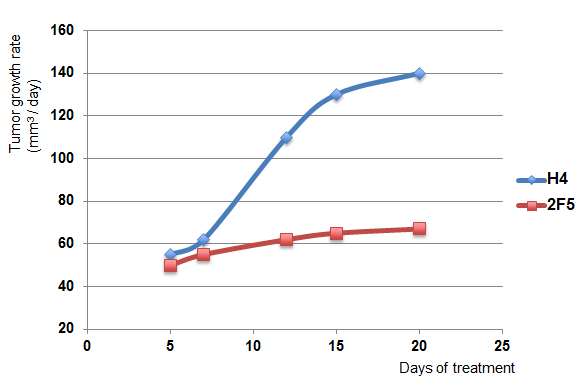
AdipoGen Life Sciences is the developer and manufacturer of the recombinant anti-Netrin-1 antibody 2F5, a potent functional antibody for investigating Netrin-1-dependent signaling in vitro and in vivo. Clone 2F5 recognizes human and mouse Netrin-1 and inhibits Netrin-1 activity through DCC and UNC5 receptors. The antibody binds Netrin-1 with a reported KD of approximately 1.5 nM and has demonstrated functional blocking activity in tumor models.
The antibody has been used in published research in areas including tumor biology, angiogenesis, neurodegeneration and inflammatory disease.
Key Features
-
Functional Netrin-1 blocking antibody
-
Human recombinant IgG2λ
-
Recognizes human and mouse Netrin-1
-
KD ≈ 1.5 nM
-
Functional blocking and ELISA applications
-
≥95% purity
-
Preservative-free
-
Suitable for in vivo research
-
25 µg trial size, 100 µg, 500 µg and bulk quantities available
A matched non-blocking antibody, anti-Netrin-1 mAb H4 (#AG-27B-0020PF), is available as a negative control.
|
Product Specifications: Clone: 2F5
Contact us at info@adipogen.com and inquire about BULK Pricing! |
|
|
|
|
Figure: anti-Netrin-1 (human), mAb (rec.) (blocking) (2F5) (preservative free) (Prod. No. AG-27B-0018PF) blocks tumor growth in vivo. Method: Tumor cells (OCI-Ly3) were implanted in SCID mice by subcutaneous injection of 3x10⁶ cells in 100µl of PBS. When tumors reached 150mm3, mice received intraperitoneal injections of blocking anti-Netrin-1 mAb (2F5) at 20 mg/kg or an equal volume of the antibody control anti-Netrin-1 (human), mAb (rec.) (H4) (preservative free) (Prod. No. AG-27B-0020PF) every two days. Tumor growth rates from the beginning of treatment are shown. |
Selected Product References:
- Epidermal Growth Factor Receptor-Dependent Mutual Amplification between Netrin-1 and the Hepatitis C Virus: M.L. Plissonnier, et al.; PLoS Biol. 14, e1002421 (2016)
- Targeting netrin-1/DCC interaction in diffuse large B-cell and mantle cell lymphomas: T. Broutier, et al.; EMBO Mol. Med. 8, 96 (2016)
- Netrin-1 acts as a non-canonical angiogenic factor produced by human Wharton’s jelly mesenchymal stem cells (WJ-MSC): C.P. Prieto, et al.; Stem Cell Res. Ther. 8, 43 (2017)
- Downregulation of the Netrin-1 Receptor UNC5b Underlies Increased Placental Angiogenesis in Human Gestational Diabetes Mellitus: C.P. Prieto, et al.; Int. J. Mol. Sci. 20, 1408 (2019)
- Netrin-1 and its receptor DCC modulate survival and death of dopamine neurons and Parkinson’s disease features: M. Jasmin, et al.; EMBO J. 40, e105537 (2021)
- Netrin-1 Secreted by Human Osteoarthritic Articular Chondrocytes Promotes Angiogenesis in Vitro: J. Akoum, et al.; Cartilage 13, 94 (2022)
Netrin-1 Research Areas
Netrin-1 and its receptors are increasingly studied across multiple research areas:
Stem Cell Biology
Pluripotency • iPS Cell Reprogramming • Naïve Stem Cells • HSC Quiescence • Self-Renewal
Cancer Research
Dependence Receptors • Apoptosis • EMT • Tumor Progression • Metastasis • Therapy Resistance
Neuroscience
Axon Guidance • Neuronal Survival • Neurodevelopment • Neurodegeneration
Immunology & Inflammation
Leukocyte Migration • Macrophage Biology • Chronic Inflammation • Vascular Inflammation
All Netrin-Related Research Products
| Product Name | PID | Source | Endotoxin | Species |
|
AG-40B-0075 |
HEK 293 cells | <0.1EU/μg | Human, Mouse, Rat | |
| Netrin-1 (human) (rec.) |
AG-40B-0040 |
HEK 293 cells | <0.01EU/μg | Human, Mouse, Rat |
| UNC5B (human):Fc (human) (rec.) | AG-40B-0037 | HEK 293 cells | <0.1EU/μg | Human, Mouse |
| Product Name | PID | Isotype | Applications | Species |
| anti-Netrin-1 (human), mAb (rec.) (blocking) (2F5) (preservative-free) | AG-27B-0018PF | Human IgG2λ | Functional, ELISA | Human, Mouse |
| anti-Netrin-1 (human), mAb (rec.) (H4) (preservative-free) |
AG-27B-0020PF |
Human IgG2λ | Functional (negative control), ELISA | Human, Mouse |
Related Pluripotency & Stem Cell Research Tools
| Product Name | PID | Source | Endotoxin | Species |
|
LIF (human) (rec.) |
AG-40B-0093 |
E. coli | <0.05EU/μg | Human, Mouse |
|
FGF-2 (human) (rec.) |
AG-40T-0040 |
E. coli | <0.1EU/μg | Human |
|
FGF-2 (human) (rec.) (untagged) |
AG-40B-0150 |
E. coli | <0.1EU/μg | Human |
Other Netrin Family Research Tools
| Product Name | PID | Isotype | Applications | Species |
| anti-Netrin-4, mAb (Nely-1) | AG-20B-0039 | Mouse IgG1κ | ELISA, Western Blot | Human, Mouse |