Cookie Policy: This site uses cookies to improve your experience. You can find out more about our use of cookies in our Privacy Policy. By continuing to browse this site you agree to our use of cookies.

AdipoGen Life Sciences
CD40L (mouse) (multimeric) (rec.)
As low as
370
CHF
CHF 370.00
In stock
Only %1 left
AG-40B-0020-C01010 µgCHF 370.00
AG-40B-0020-30103 x 10 µgCHF 740.00


Equivalent to MegaLigands

Specifications / Handling
| Product Details | |
|---|---|
| Synonyms | MultimericCD40L™; ACRP30headless:CD40L; ACRP30headless:CD154; ACRP30headless:TNFSF5; ADIPOQ-CD40L |
| Product Type | Protein |
| Properties | |
| Source/Host | CHO cells |
| Sequence | Mouse CD40L (aa 115-260) is fused at the N-terminus to mouse ACRP30headless (aa 18-111) and a FLAG®-tag. |
| Crossreactivity |
Human Mouse |
| Specificity | Binds to human and mouse CD40. |
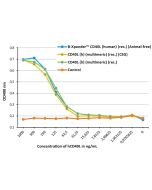
| Biological Activity | Induces B cells activation (as demonstrated by dose-dependent upregulation of CD86). |
| MW | ~35-40kDa |
| Purity | ≥95% (SDS-PAGE) |
| Endotoxin Content | <0.01EU/μg purified protein (LAL test; Lonza). |
| Concentration | 0.1mg/ml after reconstitution. |
| Reconstitution | Reconstitute with 100μl sterile water. |
| Formulation | Lyophilized. Contains PBS. |
| Other Product Data |
UniProt link P27548: CD40L (mouse) FLAG is a registered trademark of Sigma-Aldrich Co. |
| Shipping and Handling | |
| Shipping | BLUE ICE |
| Short Term Storage | +4°C |
| Long Term Storage | -20°C |
| Handling Advice |
After reconstitution, prepare aliquots and store at -20°C. Avoid freeze/thaw cycles. Centrifuge lyophilized vial before opening and reconstitution. PBS containing at least 0.1% BSA should be used for further dilutions. |
| Use/Stability |
Stable for at least 6 months after receipt when stored at -20°C. Working aliquots are stable for up to 3 months when stored at -20°C. |
| Documents | |
| Safety Data Sheet |
 Download PDF Download PDF |
| Product Specification Sheet | |
| Datasheet |
Download PDF |
Scientific Background Information
Product Description
The costimulatory molecule CD40, a member of the tumor necrosis factor (TNF) receptor superfamily, critically regulates B cell and T cell function in adaptive immunity and inflammation by interacting with CD40L (CD154). CD40L mediates a range of activities on B cells, including induction of activation-associated surface antigen, entry into cell cycle, isotype switching, immunoglobulin secretion and memory generation. CD40-CD40L interaction also plays important roles in monocyte activation and DC maturation.
MultimericCD40L™ is a high activity construct in which two trimeric CD40 ligands are artificially linked via the collagen domain of ACRP30. This construct very effectively simulates the natural membrane-assisted aggregation of CD40L in vivo. It provides a simple and equally potent alternative to CD40L+enhancer combinations. MultimericCD40L™ has shown to suppress alum-induced IL-1β release and caspase-1 activation in a dose-, CD40- and time dependent manner, without affecting BMDM (Bone marrow-derived macrophages) viability. It also effectively suppressed the inflammasome function triggered by NLRP3 activators. The secretion of caspase-1 independent inflammatory mediators has been shown to be unaltered or even enhanced. MultimericCD40L™ enhances B cell proliferation.
Product-specific References
- Two adjacent trimeric Fas ligands are required for Fas signaling and formation of a death-inducing signaling complex: N. Holler, et al.; Mol. Cell. Biol. 23, 1428 (2003) [PMC141146]
- T cells dampen innate immune responses through inhibition of NLRP1 and NLRP3 inflammasomes: G. Guarda, et al.; Nature 460, 269 (2009) [PMID: 19494813]
- NLRP10 Enhances CD4+ T-Cell-Mediated IFNγ Response via Regulation of Dendritic Cell-Derived IL-12 Release: M. Vacca, et al.; Front. Immunol. 8, 1462 (2017) [PMC5673625]
- Engaging the CD40-CD40L pathway augments T-helper cell responses and improves control of Mycobacterium tuberculosis infection: J.K. Sia, et al.; PLoS Pathog. 13, e1006530 (2017) [PMC5540402]
- Second signals rescue B cells from activation-induced mitochondrial dysfunction and death: M. Akkaya, et al.; Nat. Immunol. 19, 871 (2018) [PMC6202187]
- p38 MAPK signaling in M1 macrophages results in selective elimination of M2 macrophages by MEK inhibition: D. Baumann, et al.; J. Immunother. Cancer 9, e002319 (2021) [PMC8292803]
- 3-O sulfation of syndecan-1 mediated by the sulfotransferase HS3ST3a1 enhances myeloma aggressiveness: L. Baert, et al.; Matrix Biol. 120, 60 (2023) [PMID: 37201729]
- Blunting specific T-dependent antibody responses with engineered "decoy" B cells: R.A. Pitner, et al.; Mol. Ther. 32, 3453 (2024) [PMC11489556]
- Discrimination of Anti-Donor Response in Allogeneic Transplantation Using an Alloreactive T-Cell Detection Assay: R. Arata, et al.; Transpl. Int. 38, 13879 (2025) [PMC11810569]
- CD8+ T cell-derived CD40L mediates noncanonical cytotoxicity in CD40-expressing cancer cells: P. Schiele, et al.; Sci. Adv. 11, eadr9331 (2025) [PMC12094236]
- Integrins in engraftment of ex vivo generated plasma cells: N. Trivedi, et al.; J. Immunol. 215, vkag084 (2026) [PMID: 42096321]
- Antibody-dependent priming of spontaneous germinal centers by autoreactive B cells: D. Kim, et al.; bioRxiv (ePub ahead of Print) (2026) [Preprint]
Related Products
-
 CD40L (rat) (multimeric) (rec.) AG-40B-0107
 -
 CD40L (human) (multimeric) (rec.) AG-40B-0010
 -
anti-CD40 (mouse), mAb (FGK45) AG-20B-0036