Cookie Policy: This site uses cookies to improve your experience. You can find out more about our use of cookies in our Privacy Policy. By continuing to browse this site you agree to our use of cookies.

Chemodex
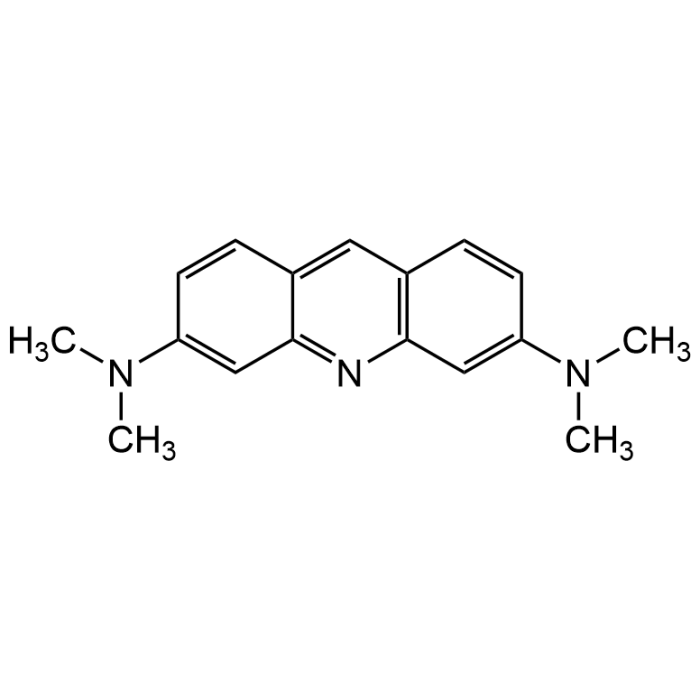
Acridine Orange Base
As low as
309
CHF
CHF 309.00
In stock
Only %1 left
CDX-A0081-G02525 gCHF 309.00


Specifications / Handling
| Product Details | |
|---|---|
| Synonyms | 3,6-Bis(dimethylamino)acridine; Solvent Orange 15; C.I. 46005B; Brilliant Acridine Orange E; Acridine orange free base; NSC 194350 |
| Product Type | Chemical |
| Properties | |
| Formula | C17H19N3 |
| MW | 265.35 |
| CAS | 494-38-2 |
| RTECS | AR7600000 |
| Source/Host Chemicals | Synthetic |
| Purity Chemicals | ≥75% (HPLC) |
| Appearance | Orange powder. |
| Solubility | Soluble in DMSO (20mg/ml). Slightly soluble in water (1mg/ml). |
| Identity | Determined by 1H-NMR. |
| Declaration | Manufactured by Chemodex. |
| Other Product Data |
Click here for Original Manufacturer Product Datasheet |
| InChi Key | DPKHZNPWBDQZCN-UHFFFAOYSA-N |
| Smiles | N=1C=2C=C(C=CC2C=C3C=CC(=CC13)N(C)C)N(C)C |
| Shipping and Handling | |
| Shipping | AMBIENT |
| Short Term Storage | +20°C |
| Long Term Storage | +20°C |
| Handling Advice | Protect from light and moisture. |
| Use/Stability | Stable for at least 2 years after receipt when stored at RT. |
| Documents | |
| Product Specification Sheet | |
| Datasheet |
 Download PDF Download PDF |
Scientific Background Information
Product Description
Acridine Orange Base is a metachromatic fluorescent dye that stains DNA and RNA. It is only slightly soluble compared to its HCL salt form. It is used as a nucleic acid-selective fluorescent cationic dye useful for cell cycle determination and staining dead cells. Being cell-permeable, it interacts with DNA and RNA by intercalation or electrostatic attractions respectively. When bound to DNA, it is very similar spectrally to fluorescein, with an excitation maximum at 502nm and an emission maximum at 525nm (green). When acridine orange associates with RNA or ssDNA, the excitation maximum shifts to 460nm (blue), and the emission maximum shifts to 650nm (red). Acridine orange will also enter acidic compartments such as lysosomes where it becomes protonated and sequestered. At low pH (inside the organelles), it will emit an orange fluorescence (peak at 590nm) and for optimal endosome visualization a blue light excitation (475nm) is used. Thus, acridine orange can be used to visualize primary lysosomes and phagolysosomes that may include products of phagocytosis of apoptotic cells. The dye is often used in epifluorescence microscopy and flow cytometry. It allows for visual detection of nucleic acids on agarose and polyacrylamide gels, can be used for differentiation of dsDNA (green fluorescence) and ssDNA/RNA (red fluorescence) and as a vitality test for determination of living cells. Spectral data: λEx=502nm, λEm=525nm (green, double strands) / λEx=460nm, λEm=650nm (red, single strands) / λEx=475nm, λEm=590nm (orange, acidic conditions).
Product-specific References
[1] F.H. Kasten; Int. Rev. Cytol. 21, 141 (1967) (Review) | [2] J.F. Golden & S.S. West; J. Histochem. Cytochem. 22, 495 (1974) | [3] J.F. Golden, et al.; J. Histochem. Cytochem. 27, 522 (1979) | [4] J.K. Frost, et al.; J. Histochem. Cytochem. 27, 545 (1979) | [5] H.W. Tyrer, et al.; J. Histochem. Cytochem. 27, 552 (1979) | [6] R.N. Paul; Stain Technol. 55, 195 (1980) | [7] S. Mirrett; Inf. Contr. Hosp. Epidemiol. 3, 250 (1982) (Review) | [8] Z. Darzynkiewicz, et al.; Curr. Protoc. Cytom. Chapter 7, Unit 7.3 (2004) (Review) | [9] J. Han & K. Burgess; Chem. Revs. 110, 2709 (2010) | [10] R.W. Sabnis; Handbook of Fluorescent Dyes and Probes (2015) | [11] M.P. Thome, et al.; J. Cell Sci. 129, 4622 (2016)