Cookie Policy: This site uses cookies to improve your experience. You can find out more about our use of cookies in our Privacy Policy. By continuing to browse this site you agree to our use of cookies.

AdipoGen Life Sciences
IFN-γ (mouse):Fc (silent) InVivoKine™
As low as
320
CHF
CHF 320.00
In stock
Only %1 left
AG-40B-0283-C05050 µgCHF 320.00


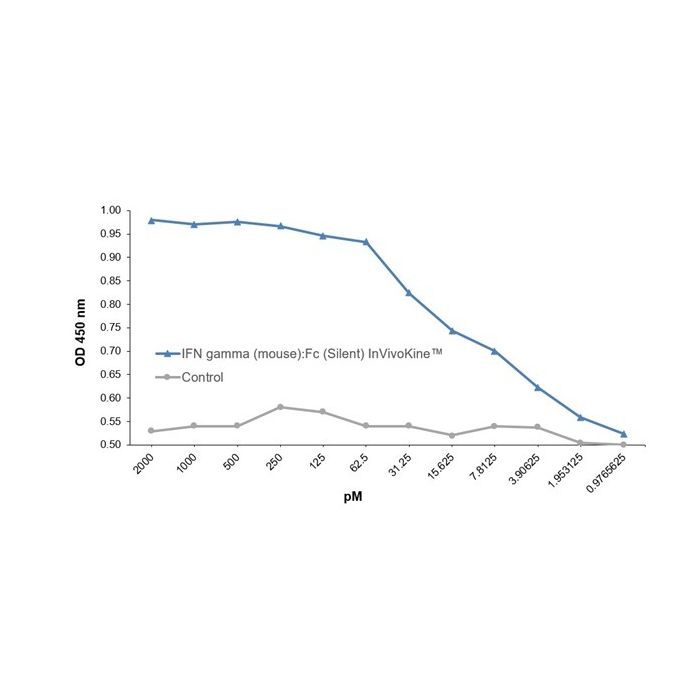
Figure 1: IFN-γ (mouse):Fc (silent) InVivoKine™ (Prod. No. AG-40B-0283) increases IL-6 (m) secretion induced by LPS.
Method: 5x10^4 Raw 264.7 cells are treated with LPS (100ng/ml; Prod. No. IAX-100-008) and with IFN-γ (mouse):Fc (silent) InVivoKine™ (Prod. No. AG-40B-0283) or a control, Fc (silent) InVivoKine™ Human IgG1 Control (Prod. No. AG-35B-0018) for 16 hours at different concentrations as indicated on the figure. Supernatants are collected, and IL-6 (mouse) is measured using an IL-6 (mouse) ELISA Kit. OD values of mouse IL-6 are shown.
Method: 5x10^4 Raw 264.7 cells are treated with LPS (100ng/ml; Prod. No. IAX-100-008) and with IFN-γ (mouse):Fc (silent) InVivoKine™ (Prod. No. AG-40B-0283) or a control, Fc (silent) InVivoKine™ Human IgG1 Control (Prod. No. AG-35B-0018) for 16 hours at different concentrations as indicated on the figure. Supernatants are collected, and IL-6 (mouse) is measured using an IL-6 (mouse) ELISA Kit. OD values of mouse IL-6 are shown.
Figure 2: Protein structure of IFN-γ (mouse):Fc (silent) InVivoKine™ (Prod. No. AG-40B-0283).
Specifications / Handling
| Product Details | |
|---|---|
| Synonyms | Interferon γ (mouse):Fc (LALA-PG) KIH (human) (rec.); Ifng; IFNG |
| Product Type | Protein |
| Properties | |
| Source/Host | HEK 293 cells. Produced using animal component-free medium. |
| Sequence |
Extracellular domain of mouse IFN-γ (aa 23-155) is fused at the C-terminus to the Fc portion of human IgG1 (LALA-PG) (Knobs-into-Holes technology) (see reference: J.B. Ridgway, et al.; Protein Eng. 9, 617 (1996)). |
| Crossreactivity | Mouse |
| Specificity |
The Fc contains the mutations LALA-PG that abolish the interaction between the Fc and FcγRs and therefore Fc undesirable effects. The Fc (LALA-PG) is named Fc (silent). |
| Biological Activity |
Induces mouse IL-6 in the presence of 100ng/ml of LPS in RAW 264.7 cells at a concentration < 10 pM. |
| MW | ~60kDa and 60kDa (SDS-PAGE) |
| Purity | ≥95% (SDS-PAGE) |
| Endotoxin Content | <0.01 EU/μg protein (LAL test). |
| Concentration | After reconstitution: 1mg/ml |
| Reconstitution | Reconstitute with 50μl endotoxin-free water. |
| Accession Number | P01580 |
| Formulation | Lyophilized. Contains PBS. |
| Protein Negative Control |
Fc (silent) InVivoKine™ (human) IgG1 Control (Prod. No. AG-35B-0018) |
| Other Product Data |
Uniprot link P01580: IFN-gamma (mouse) |
| Shipping and Handling | |
| Shipping | BLUE ICE |
| Short Term Storage | +4°C |
| Long Term Storage | -20°C |
| Handling Advice |
After reconstitution, prepare aliquots and store at -20°C. Avoid freeze/thaw cycles. Centrifuge lyophilized vial before opening and reconstitution. PBS containing at least 0.1% BSA should be used for further dilutions. |
| Use/Stability |
Stable for at least 6 months after receipt when stored at -20°C. Working aliquots are stable for up to 3 months when stored at -20°C. |
| Documents | |
| Product Specification Sheet | |
| Datasheet |
 Download PDF Download PDF |
Scientific Background Information
Product Description
Interferons (IFNs) are pleiotropic cytokines with antiviral, antitumor and immunomodulatory properties, being central coordinators of the immune response. Three major types of IFNs (type I, II and III) are distinguished by their sequence identity, genetic loci, cell of origin, nature and distribution of their receptors and resulting stimuli. Interferon-γ (IFN-γ) is the only member of the type II Interferon family. It is a homodimer formed by the non-covalent association of two 17kDa polypeptide subunits. Interferon-γ (IFN-γ) is a pleiotropic molecule with associated antiproliferative, pro-apoptotic and antitumor mechanisms. Interferon-γ is secreted predominantly by activated lymphocytes such as CD4 T helper type 1 (Th1) cells, CD8 cytotoxic T cells, γδ T cells and natural killer (NK) cells. Interferon-γ (IFN-γ) signaling is necessary for the proinflammatory activation of macrophages. IFN-γ promotes host immune response to microorganisms and plays a pivotal role in cancer immune surveillance, stimulating antitumor immunity and promoting tumor recognition and elimination. In the brain, IFN-γ has a unique role in microglial activation. Priming microglia by IFN-γ results in proliferation (microgliosis) and enhanced synapse elimination.
The IFN-γ (mouse):Fc (silent) InVivoKine™ is produced by using two different vectors, one encoding for the IFN-γ (mouse):Fc (LALA-PG) Knobs sequence (synthesizing a protein of 60kDa) and one encoding for the IFN-γ (mouse):Fc (LALA-PG) Holes sequence (synthesizing a protein of 60kDa). Both vectors transfected into HEK293 cells produce both Fc molecules (Knobs-into-Holes technology; J.B. Ridgway, et al.; Protein Eng. 9, 617 (1996)) required for dimerization of the Fc moieties and for secretion of the final protein IFN-γ (mouse):Fc (silent) InVivoKine™. This Fc-KIH format allows our IFN-γ mouse protein to form a dimer that is the most active structure. The LALA-PG mutations inhibit binding to FcγRs and C1q while FcRn binding and Fc stability remain unaffected.
InVivoKines™ are a new generation of recombinant fusion proteins for immunotherapeutic, preclinical and translational in vivo research, developed and manufactured by AdipoGen Life Sciences.
Related Products