Cookie Policy: This site uses cookies to improve your experience. You can find out more about our use of cookies in our Privacy Policy. By continuing to browse this site you agree to our use of cookies.

AdipoGen Life Sciences
ANGPTL3 (human) ELISA Kit
As low as
650
CHF
CHF 650.00
In stock
Only %1 left
AG-45A-0014YEK-KI0196 wellsCHF 650.00


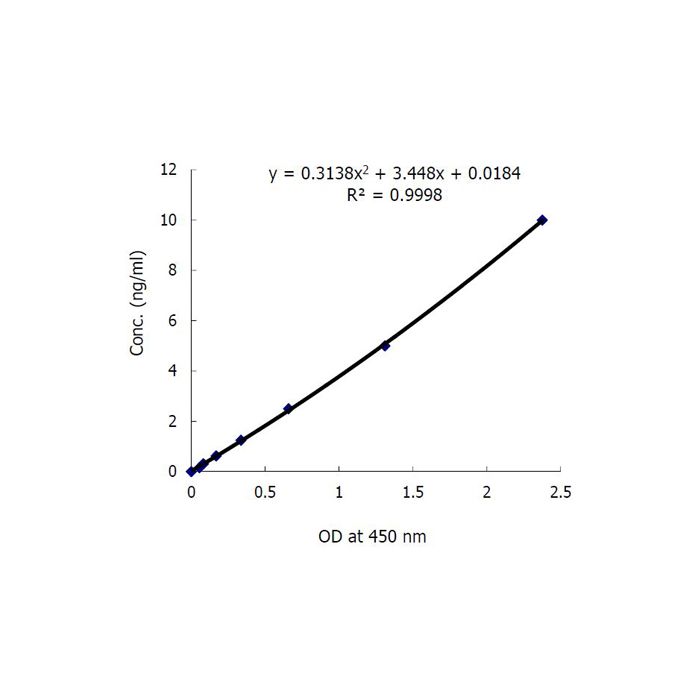
Figure 1: Standard curve
Specifications / Handling
| Product Details | |
|---|---|
| Synonyms | Angiopoietin-like Protein 3; Angiopoietin-5; ANG-5 |
| Product Type | Kit |
| Properties | |
| Application Set | Quantitative ELISA |
| Specificity | Detects human ANGPTL3. Does not cross-react with mouse ANGPTL3, human ANGPTL4, human ANGPTL6, human ANGPTL7 or human ANGPTL2. |
| Crossreactivity | Human |
| Quantity | 1 x 96 wells |
| Sensitivity | 75pg/ml |
| Range | 0.156 to 10ng/ml |
| Sample Type |
Cell Culture Supernatant Plasma Serum |
| Assay Type | Sandwich |
| Detection Type | Colorimetric |
| Shipping and Handling | |
| Shipping | BLUE ICE |
| Short Term Storage | +4°C |
| Long Term Storage | +4°C |
| Handling Advice |
After standard reconstitution, prepare aliquots and store at -20°C. Avoid freeze/thaw cycles. Plate and reagents should reach room temperature before use. |
| Use/Stability | 12 months after the day of manufacturing. See expiry date on ELISA Kit box. |
| Documents | |
| Manual |
 Download PDF Download PDF |
| Safety Data Sheet |
Download PDF |
| Product Specification Sheet | |
| Datasheet |
Download PDF |
Scientific Background Information
Product Description
Angiopoietin-like protein 3 (ANGPTL3) is a hepatokine belonging to the angiopoietin-like protein family, which shares structural features with angiopoietins but lacks direct involvement in classical vascular receptor signaling. ANGPTL3 is primarily produced in the liver and circulates in plasma as part of a functional complex that also includes ANGPTL8, which enhances its activity in the fed state. Structurally, ANGPTL3 contains an N-terminal coiled-coil domain and a C-terminal fibrinogen-like domain; proteolytic cleavage between these domains yields functionally distinct fragments with partially separable biological activities. Beyond its initial description as an angiogenic factor, ANGPTL3 is now recognized as a central regulator of systemic lipid metabolism. Genetic studies in humans and mice have shown that loss-of-function variants in ANGPTL3 are associated with familial combined hypolipidemia and reduced risk of atherosclerotic cardiovascular disease, a phenotype often referred to as “familial combined hypolipidemia.” Conversely, increased ANGPTL3 activity contributes to hypertriglyceridemia and mixed dyslipidemia. Mechanistically, ANGPTL3 inhibits both lipoprotein lipase (LPL) and endothelial lipase (EL), thereby reducing the catabolism of triglyceride-rich lipoproteins and modulating HDL metabolism. Importantly, ANGPTL3 also influences hepatic VLDL production indirectly through interactions with insulin signaling and ANGPTL8, integrating nutritional status with lipid partitioning between tissues. These insights have been reinforced by therapeutic studies showing that ANGPTL3 inhibition lowers plasma triglycerides, LDL cholesterol, and remnant lipoproteins independent of LDL receptor function. Clinically, ANGPTL3 has emerged as a promising therapeutic target for a broad spectrum of dyslipidemias. Monoclonal antibodies (e.g., evinacumab) and antisense oligonucleotides targeting ANGPTL3 have demonstrated significant lipid-lowering effects in patients with refractory hypercholesterolemia, including those with homozygous familial hypercholesterolemia. Collectively, these findings position ANGPTL3 as a key endocrine regulator linking hepatic nutrient sensing to systemic lipid homeostasis and cardiovascular risk. The ANGPTL3 (human) ELISA Kit is to be used for the in vitro quantitative determination of human ANGPTL3 in serum, plasma and cell culture supernatant.
Product-specific References
- Exercise training restores the endothelial response to vascular growth factors in patients with stable coronary artery disease: E.B. Beck, et al.; Eur. J. Prev. Cardiol. 19, 412 (2012)
- Characterization of three kindreds with familial combined hypolipidemia caused by loss-of-function mutations of ANGPTL3: L. Pisciotta, et al.; Circ. Cardiovasc. Gent. 5, 42 (2012)
- Atypical angiopoietin-like protein that regulates ANGPTL3: F. Quagliarini, et al.; PNAS 109, 19751 (2012)
- Clinical characteristics and plasma lipids in subjects with familial combined hypolipidemia: a pooled analysis: I. Minicocci, et al.; J. Lipid Res. 54, 3481 (2013)
- Identification of adipokine clusters related to parameters of fat mass, insulin sensitivity and inflammation: G. Flehmig, et al.; PLos One 9, e99785 (2014)
- Persistence of HCV in Acutely-Infected Patients Depletes C24-Ceramide and Upregulates Sphingosine and Sphinganine Serum Levels: G. Grammatikos, et al.; Int. J. Mol. Sci. 17, 922 (2016)
- ANGPTL3 and ANGPTL8 in Thai subjects with hyperalphalipoproteinemia and severe hypertriglyceridemia: C. Kaewkrasaesin, et al.; J. Clin. Lipidol. 15, 752 (2021)
Related Products