Cookie Policy: This site uses cookies to improve your experience. You can find out more about our use of cookies in our Privacy Policy. By continuing to browse this site you agree to our use of cookies.

DDX1 - A Versatile RNA Helicase

DDX1 (Dead-Box Helicase 1) belongs to the DEAD-Box family of ATP-dependent RNA helicases, whose members are collectively involved in almost all aspects of RNA processing: from transcription to remodeling to degradation. They are named for the central Asp-Glu-Ala-Asp (DEAD) sequence they all possess. The 35 human DEAD-Box proteins comprise the largest family of helicases known.
DDX1 was first found due to its overexpression in retinoblastoma. It is a 740 amino acid protein, weighing in at about 82 kDa. From bow to stern, it consists of an N-terminal Rec A-like domain containing a Q motif that mediates ATP binding and hydrolysis, a SPRY motif involved in protein-protein recognition, and the signature DEAD sequence. This is followed by a hinge region and a C-terminal Rec A domain. While both domains share and cooperate in conformationally dictated ATP binding and hydrolysis, RNA binding, and helicase functions, the N-terminal domain principally orchestrates ATP binding and hydrolysis, while the C-terminal domain controls RNA binding and helicase activities. The Q motif is unique to DEAD-Box helicases, but DDX1 is the only DEAD-Box helicase to possess a SPRY motif.

DDX1 Juggles Many Roles
In its RNA helicase capacity, DDX1 regulates translation initiation, nuclear RNA splicing, ribosome synthesis, and mRNA synthesis/stability. However, as research progresses, more roles for DDX1 are constantly emerging. While it is usually found in the nucleus, DDX1 is also found in the cytoplasm of transformed cells. It binds to poly(A) RNA and may influence the polyadenylation and 3′-end cleavage of mRNA. Even though DDX1’s ATPase acts solely on RNA and not DNA, it does help to clear RNA from DNA double-strand breaks and aid in repair. DDX1 is also a component of the t-RNA-splicing ligase complex. Most recently, DDX1 has been found to participate in the Drosha microprocessor that directs the transcriptional maturation of certain miRNAs.
Involvement in Innate Immunity
In the area of innate immunity, DDX1 participates in the TICAM1 complex, a cytoplasmic sensor of viral double-stranded (ds) RNA. DDX1 recognizes and binds both short and long stretches of dsRNA. When activated, this complex activates cellular antiviral responses and the release of inflammatory cytokines. Similarly, DDX1 acts with RELA to enhance NF-kappa-Beta expression. DDX1 interacts with Viral Protein 3D in Foot and Mouth Disease Virus to inhibit its replication and induce the Type I IFN response. DDX1 also binds the NSP14 protein of Transmissible Gastroenteritis Virus to induce Interferon-Beta. However, the NSP14s from Coronavirus Infectious Bronchitis Virus and SARS-CoV have evolved to interact with DDX1 in a way that blunts its innate immunity function and enhances viral replication.
Targeting DDX1 for Disease
From the time it was identified, DDX1’s role in cancer has only expanded. While this helicase is present in all cells and is most abundant in testicular tissue, its abnormal abundance in transformed tissues is proving to be important in cancer progression. DDX1’s influence on transcription, RNA structures, and metastasis is emerging in testicular, colorectal, liver, ovarian, and breast cancer.
Recent work on the influence of hyperlipidemia on insulin resistance has revealed that high levels of palmitate ingestion repress the production of insulin by interfering with proper DDX1 processing of insulin mRNA. As a result, adequate insulin isn’t produced, and blood glucose levels dysregulate.
The Transcreener Assay Measures ATPase Activity of Helicases
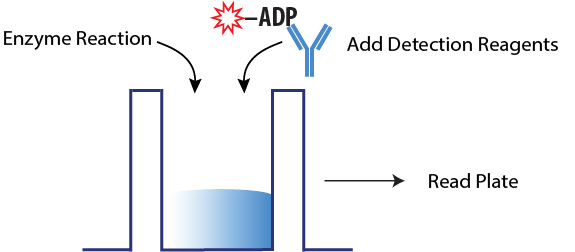 Transcreener is a biochemical HTS-ready assay capable of measuring ATPase activity via direct detection of ADP produced during ATP hydrolysis. This assay allows researchers to investigate if a molecule is a good candidate to pursue as a new clinically relevant drug.
Assay Features:
- Easy to use, homogenous, one-step format
- Robust Assay Z' > 0.7 under initial velocity conditions
- Far-red fluorescent readouts minimize compound interference
- Safe, non-radioactive method
- Kinetic mode capable
- Universal - Use with virtually any ATPase enzyme
Run the Enzyme Reaction, Add Reagents, and Read Plate... That's It!
STANDARD Transcreener® ADP2 Assays
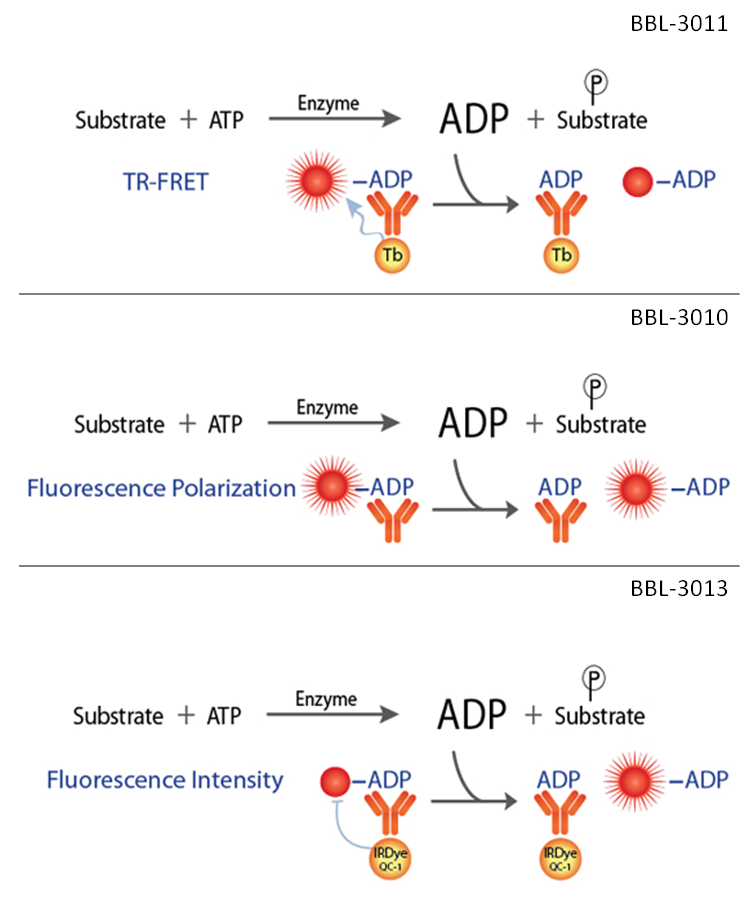
Transcreener ADP2 Kinase Assay Kits rely on direct detection of ADP using a proprietary antibody that binds with exquisite specificity and affinity to ADP, with negligible cross-reactivity to ATP. This exquisite selectivity allows direct detection of ADP in the presence of an excess of ATP, a requirement for kinase activity assays run under initial velocity conditions (e.g., ≤10% ATP consumption). The Transcreener ADP2 assay is available in three fluorescent readouts, which provide a safe HTS-compatible alternative to cumbersome radioassay methods and are more sensitive and less subject to interference than other detection methods. All readouts use far-red tracers to minimize compound interference and lower false-positive rates.
i) The Transcreener® ADP2 TR-FRET Assay (Prod. No. BBL-3011) is a is competitive immunoassay with a far-red time-resolved Förster resonance-energy-transfer readout.
ii) The Transcreener® ADP2 FP Assay (Prod. No. BBL-3010) is a competitive far-red fluorescence polarization (FP) assay.
iii) The Transcreener® ADP2 FI Assay (Prod. No. BBL-3013) is a competitive red fluorescence intensity (FI) assay.
Because they are highly selective for ADP, these assays can be used with any enzyme that converts ATP to ADP, regardless of what other substrates are used. Examples of enzymes include protein, lipid, and carbohydrate kinases, ATPases, DNA helicases, carboxylases, and glutamine synthetase.
| Product Name | PID / Manual | Detection |
| Transcreener® ADP2 TR-FRET Assay | BBL-3011 | TR-FRET |
| Transcreener® ADP2 FP Assay | BBL-3010 | Fluorescent Polarization |
| Transcreener® ADP2 FI Assay | BBL-3013 | Fluorescent Intensity |
For Detailed information please see the Transcreener® HTS Assay Overview Page and download BellBrook Labs Guide to "Measuring Drug-Target Residence Times with Biochemical Assay"
For Instrument Compatibility Table
AdipoGen Life Sciences provides the complete BellBrook Labs product range in Switzerland and Italy. For an overview please see below or contact us if you request further information.
For Product Inquiries: info@adipogen.com