Cookie Policy: This site uses cookies to improve your experience. You can find out more about our use of cookies in our Privacy Policy. By continuing to browse this site you agree to our use of cookies.

Chemodex
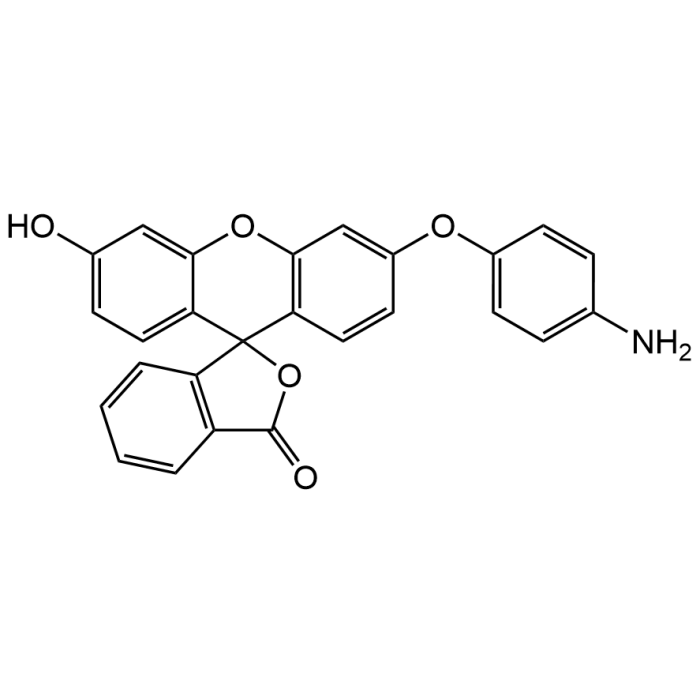
Aminophenyl-fluorescein
As low as
258
CHF
CHF 258.00
In stock
Only %1 left
CDX-A0054-M0011 mgCHF 258.00
CDX-A0054-M0055 mgCHF 967.00
NEW


Specifications / Handling
| Product Details | |
|---|---|
| Synonyms | APF; 3′-p-(Aminophenyl) fluorescein; 2-[6-(4′-Amino)phenoxy-3H-xanthen-3-on-9-yl]benzoic acid; 3′-(4-Aminophenoxy)-6′-hydroxyspiro[isobenzofuran-1(3H),9′-[9H]xanthen]-3-one |
| Product Type | Chemical |
| Properties | |
| Formula | C26H17NO5 |
| MW | 423.42 |
| CAS | 359010-70-1 |
| Source/Host Chemicals | Synthetic |
| Purity Chemicals | ≥98% (HPLC) |
| Appearance | Light yellow to orange powder. |
| Solubility | Soluble in DMF, DMSO, ethanol or methanol (all 10mg/ml). Insoluble in water. |
| Identity | Determined by 1H-NMR. |
| Declaration | Manufactured by Chemodex. |
| Other Product Data |
Click here for Original Manufacturer Product Datasheet |
| InChi Key | SKRNNOWWEXPZBB-UHFFFAOYSA-N |
| Smiles | O=C1OC2(C3=CC=C(O)C=C3OC4=CC(OC5=CC=C(N)C=C5)=CC=C42)C=6C=CC=CC16 |
| Shipping and Handling | |
| Shipping | AMBIENT |
| Short Term Storage | +4°C |
| Long Term Storage | -20°C |
| Handling Advice | Protect from light and moisture. |
| Use/Stability | Stable for at least 2 years after receipt when stored at -20°C. |
| Documents | |
| Product Specification Sheet | |
| Datasheet |
 Download PDF Download PDF |
Scientific Background Information
Product Description
APF is a cell-permeable fluorogenic probe for highly reactive radicals. It has low intrinsic fluorescence, however, upon oxidation by hydroxyl radical, hypochlorite ion, and certain peroxidase intermediates, it is converted to the highly fluorescent molecule fluorescein, facilitating the detection of highly reactive biological radicals. APF can be used to detect intracellular reactive oxygen species (ROS). APF is not oxidized by nitric oxide (NO), hydrogen peroxide (H2O2) or other oxidants. Spectral Data of Fluorescein: Ex/Em maxima 490/515 nm.
Product-specific References
(1) K. Setsukinai, et al.; J. Biol. Chem. 278, 3170 (2003) | (2) J. Flemmig, et al.; J. Biol. Chem. 287, 27913 (2012) | (3) T.K. Kim, et al.; Chemosphere 208, 441 (2018) | (4) H. Tamura, et al.; Neurotoxicol. 95, 173 (2023)