Cookie Policy: This site uses cookies to improve your experience. You can find out more about our use of cookies in our Privacy Policy. By continuing to browse this site you agree to our use of cookies.

Chemodex
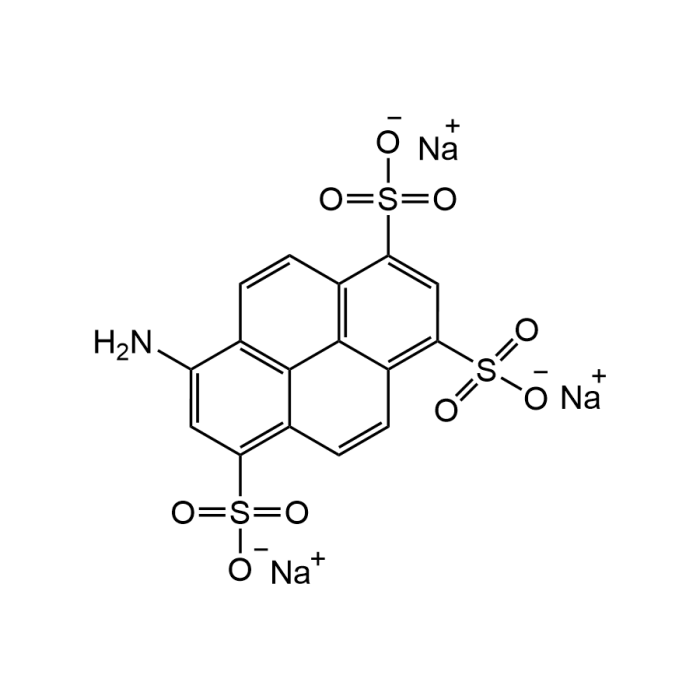
8-Aminopyrene-1,3,6-trisulfonic acid trisodium salt
As low as
84
CHF
CHF 84.00
In stock
Only %1 left
CDX-A0097-M0055 mgCHF 84.00
CDX-A0097-M02525 mgCHF 284.00
NEW


Specifications / Handling
| Product Details | |
|---|---|
| Synonyms | APTS; 1,3,6-Pyrenetrisulfonic acid, 8-amino trisodium salt; Trisodium 8-aminopyrene-1,3,6-trisulfonate |
| Product Type | Chemical |
| Properties | |
| Formula | C16H8NNa3O9S3 |
| MW | 523.4 |
| CAS | 196504-57-1 |
| Source/Host Chemicals | Synthetic |
| Purity Chemicals | ≥96% (HPLC) |
| Appearance | Yellow to dark yellow powder. |
| Solubility | Soluble in water (10mg/ml), DMF or DMSO (1mg/ml). |
| Identity | Determined by 1H-NMR. |
| Declaration | Manufactured by Chemodex. |
| Other Product Data |
Click here for Original Manufacturer Product Datasheet |
| InChi Key | XSTNYACEWLNWPY-UHFFFAOYSA-K |
| Smiles | [Na+].[Na+].[Na+].Nc1cc(c2ccc3c(cc(c4ccc1c2c34)S([O-])(=O)=O)S([O-])(=O)=O)S([O-])(=O)=O |
| Shipping and Handling | |
| Shipping | AMBIENT |
| Short Term Storage | +4°C |
| Long Term Storage | -20°C |
| Handling Advice | Protect from light and moisture. |
| Use/Stability | Stable for at least 2 years after receipt when stored at -20°C. |
| Documents | |
| Product Specification Sheet | |
| Datasheet |
 Download PDF Download PDF |
Scientific Background Information
Product Description
8-Aminopyrene-1,3,6-trisulfonic acid (APTS) is an anionic fluorescent dye. It forms a ground state complex with viologen-type quenchers, inducing a red-shift in the absorbance spectrum from 425 to 464 nm. APTS is pH insensitive, with the emission maximum remaining constant over the pH range of 4-10. APTS is a highly fluorescent labeling reagent widely used for glycan and carbohydrate analysis. Through reductive amination, APTS efficiently labels reducing sugars, enabling sensitive detection and high-resolution separation by capillary electrophoresis with laser-induced fluorescence (CE-LIF). Spectral Data: Ex/Em maxima 425/503 nm (in pH 7.4 PBS).
Product-specific References
(1) R.A. Evangelista, et al.; Electrophoresis 17, 347 (1996) | (2) Y. Yoshinaka, et al.; J.Chromatogr. 1143, 83 (2007) | (3) Z. Sharrett, et al.; Org. Biomol. Chem. 7, 1461 (2009) | (4) P. Smejkal, et al.; Electrophoresis 31, 3783 (2010) | (5) D.B. Cordes & B. Singaram; Pure Appl. chem. 84, 2183 (2012) | (6) S.C. Bunz, et al.; Anal. Bioanal. Chem. 405, 8277 (2013) | (7) H.T. Feng, et al.; Electrophoresis 38, 1788 (2017) | (8) S. Yamamoto, et al.; J. Chromatogr. A. 1566, 44 (2018) | (9) J. Krenkova, et al.; Electrophoresis 42, 1333 (2021) | (10) Y. Deng, et al.; J. Pharm. Anal. 13, 201 (2023) | (11) J.M. Garber, et al.; Methods Mol. Biol. 2657, 223 (2023)