Cookie Policy: This site uses cookies to improve your experience. You can find out more about our use of cookies in our Privacy Policy. By continuing to browse this site you agree to our use of cookies.

Chemodex
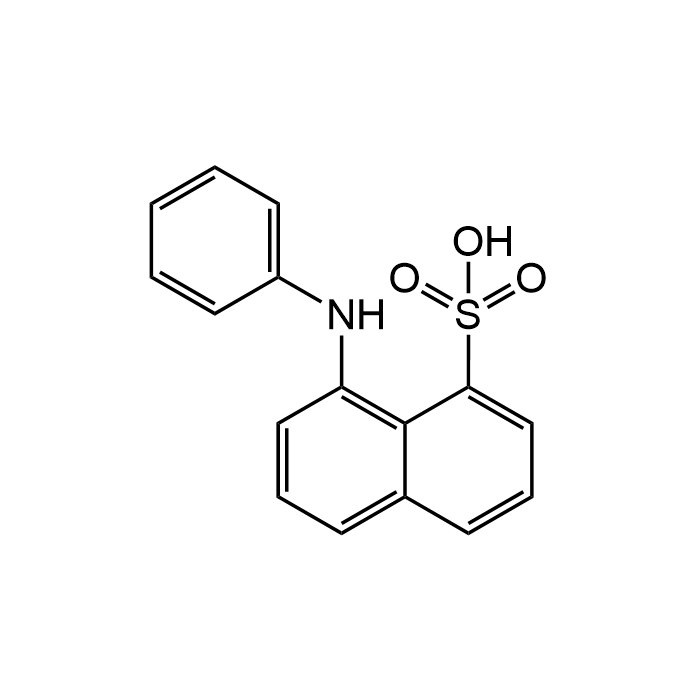
8-Anilino-1-naphthalenesulfonic acid
As low as
116
CHF
CHF 116.00
In stock
Only %1 left
CDX-A0112-G02525 gCHF 116.00
CDX-A0112-G100100 gCHF 354.00


Specifications / Handling
| Product Details | |
|---|---|
| Synonyms | N-Phenyl peri acid; 1,8-ANS; ANS; ANSA; 8-Anilino-1-naphthalenesulfonate; 1-Anilino-8-naphthalenesulfonic acid; NSC 1746 |
| Product Type | Chemical |
| Properties | |
| Formula | C16H13NO3S |
| MW | 299.34 |
| CAS | 82-76-8 |
| Source/Host Chemicals | Synthetic |
| Purity Chemicals | ≥97% (HPLC) |
| Appearance | Gray to dark green to black powder. |
| Solubility | Soluble in DMSO (20mg/ml), DMF (50 mg/ml) or methanol (20mg/ml). Slightly soluble in water (<1mg/ml). |
| Identity | Determined by 1H-NMR. |
| Declaration | Manufactured by Chemodex. |
| Other Product Data |
Click here for Original Manufacturer Product Datasheet |
| InChi Key | FWEOQOXTVHGIFQ-UHFFFAOYSA-N |
| Smiles | O=S(=O)(O)C1=CC=CC2=CC=CC(NC=3C=CC=CC3)=C21 |
| Shipping and Handling | |
| Shipping | AMBIENT |
| Short Term Storage | +20°C |
| Long Term Storage | +20°C |
| Handling Advice | Protect from light and moisture. |
| Use/Stability | Stable for at least 2 years after receipt when stored at RT. |
| Documents | |
| Product Specification Sheet | |
| Datasheet |
 Download PDF Download PDF |
Scientific Background Information
Product Description
8-Anilino-1-naphthalenesulfonic acid (ANS) is a widely used environment-sensitive fluorescent probe for studying protein structure, conformational changes, and hydrophobic surface exposure. ANS exhibits weak fluorescence in aqueous solutions but shows a strong increase in fluorescence intensity and a blue shift in emission upon binding to hydrophobic regions of proteins, membranes, or macromolecular complexes. This property makes ANS an essential tool for protein folding/unfolding studies, ligand-binding assays, and investigations of protein–protein interactions. It is commonly applied in biochemical and biophysical research to monitor changes in protein conformation under varying conditions such as pH, temperature, or denaturant concentration. Spectral data: λex 371 nm, λem 480 nm in methanol.
Product-specific References
[1] N. Gains & A.P. Dawson AP; Biochem. J. 148, 157 (1975) | [2] V. Cody & J. Hazel; BBRC 68, 425 (1976) | [3] X.C. Yu & H.W. Strobel; Mol. Cell Biochem. 162, 89 (1996) | [4] J. Ishida, et al.; Biol. Pharm. Bull. 19, 1391 (1996) | [5] J. Malecki & Z. Wasylewski; J. Protein Chem. 17, 745 (1998) | [6] M. Andujar-Sanchez, et al.; J. Mol. Recognit. 24, 548 (2011) | [7] H.K. Vivek, et al.; Anal. Biochem. 461, 27 (2014) | [8] C. Ota & K. Takano; Chemphyschem. 20, 1456 (2019) | [9] E.B. Faber, et al.; ACS Chem. Biol. 15, 1759 (2020)