Cookie Policy: This site uses cookies to improve your experience. You can find out more about our use of cookies in our Privacy Policy. By continuing to browse this site you agree to our use of cookies.

Chemodex
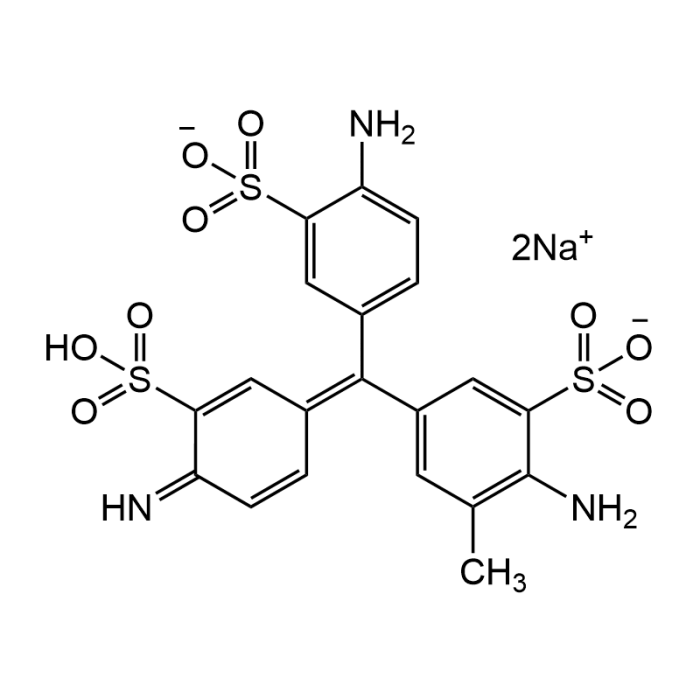
Acid Fuchsin
As low as
103
CHF
CHF 103.00
In stock
Only %1 left
CDX-A0351-G02525 gCHF 103.00
CDX-A0351-G05050 gCHF 155.00
NEW


Specifications / Handling
| Product Details | |
|---|---|
| Synonyms | C.I. Acid Violet 19; Fuchsin S; Fuchsin acid; Rubine S; C.I. 42685; Acid Red |
| Product Type | Chemical |
| Properties | |
| Formula | C20H17N3Na2O9S3 |
| MW | 585.54 |
| CAS | 3244-88-0 |
| RTECS | DD4737000 |
| Source/Host Chemicals | Synthetic |
| Purity Chemicals | ≥70% (Dye content) |
| Appearance | Blue to green powder. |
| Solubility | Soluble in DMSO (5 mg/ml) or water (1 mg/ml). |
| Declaration | Manufactured by Chemodex. |
| Other Product Data |
Click here for Original Manufacturer Product Datasheet |
| InChi Key | WZRZTHMJPHPAMU-UHFFFAOYSA-L |
| Smiles | [Na+].[Na+].Cc1cc(cc(c1N)S([O-])(=O)=O)\C(c2ccc(N)c(c2)S([O-])(=O)=O)=C3/C=CC(=N)C(=C3)S(O)(=O)=O |
| Shipping and Handling | |
| Shipping | AMBIENT |
| Short Term Storage | +20°C |
| Long Term Storage | +20°C |
| Handling Advice | Protect from light and moisture. |
| Use/Stability | Stable for at least 2 years after receipt when stored at RT. |
| Documents | |
| Product Specification Sheet | |
| Datasheet |
 Download PDF Download PDF |
Scientific Background Information
Product Description
Acid Fuchsin is a magenta-colored acidic triphenylmethane dye widely used in histology, microbiology and staining applications. It selectively binds to cytoplasmic components and collagen-rich tissues, making it useful in differential staining protocols such as Masson’s trichrome. The dye is also applied in microbial staining techniques and as a biological stain in microscopy for enhanced contrast and visualization of cellular structures. Acid Fuchsin has also been described to be a potent Inhibitor of amyloid formation by human islet amyloid polypeptide.
Product-specific References
(1) W.L. Holman.; J. Inf. Dis. 15, 227 (1914) | (2) F.J. Leinweber & K.J. Monty; Methods Enzymol. 143, 160 (1987) | (3) L.F. Nielsen, et al.; Biotech. Histochem. 73, 71 (1998) | (4) K.A. Rider & L.M. Flick; Anal. Quant. Cytol. Histol. 26, 246 (2004) | (5) G. Vinitha & A. Ramalingam; Spectrochim. Acta A Mol. Biomol. Spectrosc. 69, 1160 (2008) | (6) F. Meng, et al.; J. Mol. Biol. 400, 555 (2010) | (7) K. Gupta, et al.; Biotech. Histochem. 87, 249 (2012) | (8) K.T. Clarke, et al.; Forensic Sci. Int. 363, 112198 (2024)