Cookie Policy: This site uses cookies to improve your experience. You can find out more about our use of cookies in our Privacy Policy. By continuing to browse this site you agree to our use of cookies.

Chemodex
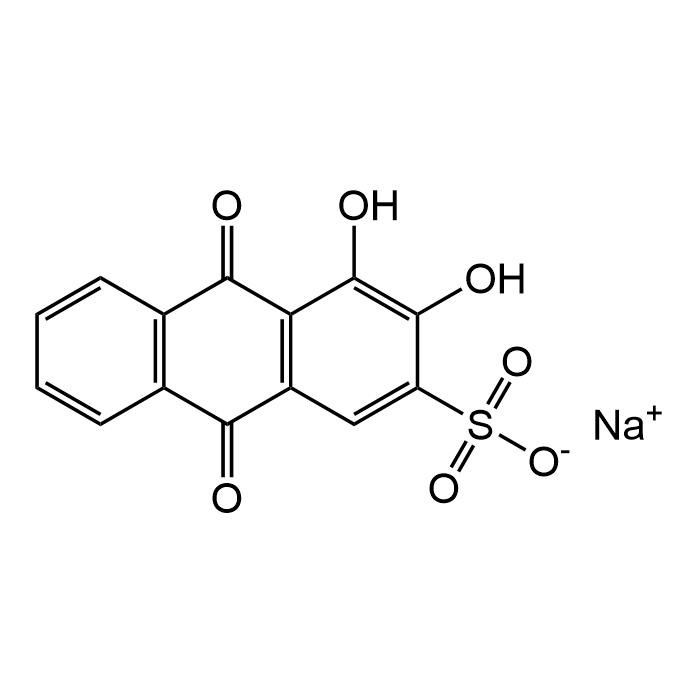
Alizarin Red S
As low as
77
CHF
CHF 77.00
In stock
Only %1 left
CDX-A0670-G05050 gCHF 77.00


Specifications / Handling
| Product Details | |
|---|---|
| Synonyms | 3,4-Dihydroxy-9,10-dioxo-2-anthracenesulfonic acid sodium salt; C.I. 58005; Alizarin Carmine; Alizarin Red; Alizarinsulfonate; Ahcoquinone Red S; Alizarin sulfonate sodium; Chrome Red Alizarine |
| Product Type | Chemical |
| Properties | |
| Formula | C14H7NaO7S |
| MW | 342.26 |
| CAS | 130-22-3 |
| RTECS | CB1095300 |
| Source/Host Chemicals | Synthetic |
| Purity Chemicals | ≥70% (Dye content) |
| Appearance | Brownish yellow powder. |
| Solubility | Soluble in DMSO (10mg/ml) or water (1mg/ml). |
| Declaration | Manufactured by Chemodex. |
| Other Product Data |
Click here for Original Manufacturer Product Datasheet |
| InChi Key | HFVAFDPGUJEFBQ-UHFFFAOYSA-M |
| Smiles | [Na+].Oc1c(O)c(cc2C(=O)c3ccccc3C(=O)c12)S([O-])(=O)=O |
| Shipping and Handling | |
| Shipping | AMBIENT |
| Short Term Storage | +20°C |
| Long Term Storage | +20°C |
| Handling Advice | Protect from light and moisture. |
| Use/Stability | Stable for at least 2 years after receipt when stored at RT. |
| Documents | |
| Product Specification Sheet | |
| Datasheet |
 Download PDF Download PDF |
Scientific Background Information
Product Description
Alizarin Red S is a well-established anionic anthraquinone dye widely used as a pH indicator or for the detection and quantification of calcium and other divalent metal ions. It forms a bright red to orange-red complex with calcium salts, making it a standard reagent for histological staining and cell culture assays involving mineralization. In biomedical research, Alizarin Red S is most commonly used to assess osteogenic differentiation by staining calcium deposits in cultured cells and tissue sections. The dye is also employed in analytical chemistry and materials science for metal ion binding studies due to its strong chelation properties. Its strong color response and reliable metal-binding properties make it an excellent choice for osteogenesis studies, histological staining, and spectrophotometric analysis in both research and quality control laboratories. It acts as a colorometric pH indicator. 1st transition range: pH 4.3 - pH 6.3 Lightly yellow - pink/red. 2nd transition range: pH 9.4 - pH 12.0 Brown orange - violet.
Product-specific References
[1] K.F. Adkins; Stain Technol. 40, 69 (1965) | [2] H. Puchtler, et al.; J. Histochem. Cytochem. 17, 110 (1969) | [3] P. Virtanen & K. Isotupa; Acta Anat. 108, 202 (1980) | [4] F. Eggelmeijer, et al.; Clin. Exp. Rheumatol. 9, 11 (1991) | [5] K. Basavaiah, et al.; Talanta 50, 887 (1999) | [6] G. Springsteen & B. Wang; Chem. Commun. 7, 1608 (2001) | [7] I. Sahin & N. Nakiboglu; Anal. Chim. Acta 572, 253 (2006) | [8] S.A. Sangsefedi, et al.; J. Fluoresc. 28, 815 (2018) | [9] W. Ma, et al.; Polymers 11, 165 (2019) | [10] A. Bernar, et al.; Int. J. Mol. Sci. 24, 723 (2022) | [11] C.A.N. Catalan, et al.; Molecules 30, 3286 (2025)