Cookie Policy: This site uses cookies to improve your experience. You can find out more about our use of cookies in our Privacy Policy. By continuing to browse this site you agree to our use of cookies.

Chemodex
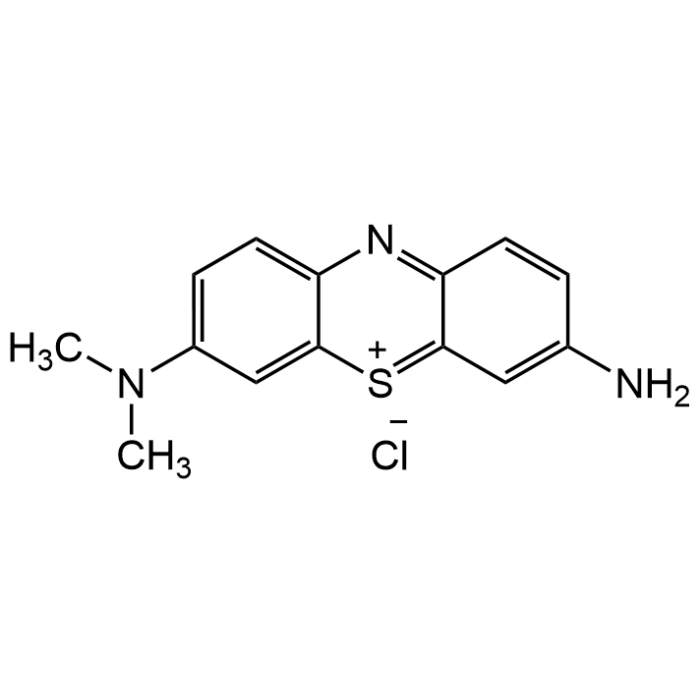
Azure A chloride
As low as
122
CHF
CHF 122.00
In stock
Only %1 left
CDX-A0673-G05050 gCHF 122.00
CDX-A0673-G100100 gCHF 219.00
NEW


Specifications / Handling
| Product Details | |
|---|---|
| Synonyms | Azure A dye; 3-Amino-7-(dimethylamino)phenazathionium chloride; N,N-Dimethylthionine; C.I. 52005; Azure Blue Cert |
| Product Type | Chemical |
| Properties | |
| Formula | C14H14ClN3S |
| MW | 291.8 |
| CAS | 531-53-3 |
| Source/Host Chemicals | Synthetic |
| Purity Chemicals | ≥80% (Dye content) |
| Appearance | Dark green to black powder. |
| Solubility | Slightly soluble in water or DMSO (0.1 - 1mg/ml). |
| Declaration | Manufactured by Chemodex. |
| Other Product Data |
Click here for Original Manufacturer Product Datasheet |
| InChi Key | PGWTYMLATMNCCZ-UHFFFAOYSA-M |
| Smiles | [Cl-].N=1C2=CC=C(N)C=C2[S+]=C3C=C(C=CC13)N(C)C |
| Shipping and Handling | |
| Shipping | AMBIENT |
| Short Term Storage | +20°C |
| Long Term Storage | +20°C |
| Handling Advice | Protect from light and moisture. |
| Use/Stability | Stable for at least 2 years after receipt when stored at RT. |
| Documents | |
| Product Specification Sheet | |
| Datasheet |
 Download PDF Download PDF |
Scientific Background Information
Product Description
Azure A chloride is a cationic thiazine dye widely used in histology and microbiology for staining cellular structures. It displays an absorbance maximum between 620-634 nm in water. It exhibits strong affinity for acidic tissue components such as nucleic acids, making it useful in procedures that highlight nuclei and other basophilic elements. It is commonly used in combination staining methods (e.g., Romanowsky-type stains) for blood smears and tissue sections, providing clear contrast of cellular morphology. Azure A Chloride is commonly used as a nucleic acid (DNA/RNA) stain. It is a basic (cationic) dye that binds strongly to negatively charged nucleic acids, meaning it can stain DNA (especially in nuclei) and RNA (often even more strongly than DNA in some protocols). Azure A has also been used as a starting material in the synthesis of DNA damage-sensing electrochemical probes and NADH-detecting electrodes.
Product-specific References
(1) A. Wollin & L.B. Jaques; Can. J. Physiol. Pharmacol. 50, 65 (1972) | (2) P.J. Bennion, et al.; Stain. Technol. 50, 307 (1975) | (3) C. Doriguzzi, et al.; Histochemistry 79, 289 (1983) | (4) P. Chieco, et al.; Histochem. J. 25, 569 (1993) | (5) V. Grill, et al.; Biotech. Histochem. 70, 75 (1975) | (6) R.W. Sabnis; Handbook of biological dyes and stains (2010) | (7) M. Revenga-Parra, et al.; Anal. Chim. Acta 747, 84 (2012) | (8) P. Paul & G. Suresh Kumar; Spectrochim. Acta A Mol. Biomol. Spectrosc. 107, 303 (2013) | (9) A. Porfireva, et al.; Sensors 21, 2949 (2021)