Cookie Policy: This site uses cookies to improve your experience. You can find out more about our use of cookies in our Privacy Policy. By continuing to browse this site you agree to our use of cookies.

Chemodex
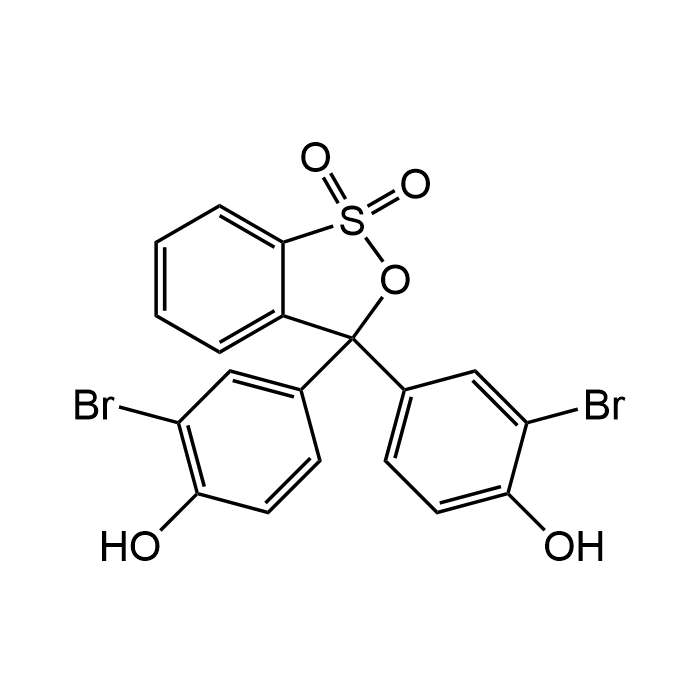
Bromphenol red
As low as
155
CHF
CHF 155.00
In stock
Only %1 left
CDX-B0050-G0055 gCHF 155.00
NEW


Specifications / Handling
| Product Details | |
|---|---|
| Synonyms | Bromophenol red; 3′,3′′-Dibromophenolsulfonphthalein; BPR |
| Product Type | Chemical |
| Properties | |
| Formula | C19H12Br2O5S |
| MW | 512.17 |
| CAS | 2800-80-8 |
| Source/Host Chemicals | Synthetic |
| Purity Chemicals | ≥95% (Dye content) |
| Appearance | Red to brown powder. |
| Solubility | Soluble in ethanol. Sparingly soluble in aqueous buffer. |
| Declaration | Manufactured by Chemodex. |
| Other Product Data |
Click here for Original Manufacturer Product Datasheet |
| InChi Key | OYCLSQDXZMROJK-UHFFFAOYSA-N |
| Smiles | C1=CC=C2C(=C1)C(OS2(=O)=O)(C3=CC(=C(C=C3)O)Br)C4=CC(=C(C=C4)O)Br |
| Shipping and Handling | |
| Shipping | AMBIENT |
| Short Term Storage | +4°C |
| Long Term Storage | +4°C |
| Handling Advice | Protect from light and moisture. |
| Use/Stability | Stable for at least 2 years after receipt when stored at +4°C. |
| Documents | |
| Product Specification Sheet | |
| Datasheet |
 Download PDF Download PDF |
Scientific Background Information
Product Description
Bromophenol Red is a sulfonephthalein pH indicator widely used in analytical chemistry, biochemistry, and laboratory research. It undergoes a distinct color transition from yellow to red over a pH range of 5.2-6.8, making it suitable for monitoring mildly acidic to near-neutral solutions. The dye exhibits an absorbance maximum at approximately 433 nm in its acidic form and 558 nm in its basic form, enabling both visual and spectrophotometric pH measurements. Spectral Data: λmax=574 nm. Bromophenol Red is commonly used in acid-base titrations, indicator formulations, and analytical assays. Bromophenol red (sultone form) binds to lysozyme and inhibits its activity against the bacterial cell wall, but not the polysaccharide component of peptidoglycan.
Product-specific References
(1) G. Krishnamoorthy, et al.; Biopolym. 18, 1937 (1979) | (2) V.M. Madhusudan; Protein Eng. 5, 399 (1992) | (3) X. Yu, et al.; Talanta 148, 264 (2016)