Cookie Policy: This site uses cookies to improve your experience. You can find out more about our use of cookies in our Privacy Policy. By continuing to browse this site you agree to our use of cookies.

Chemodex
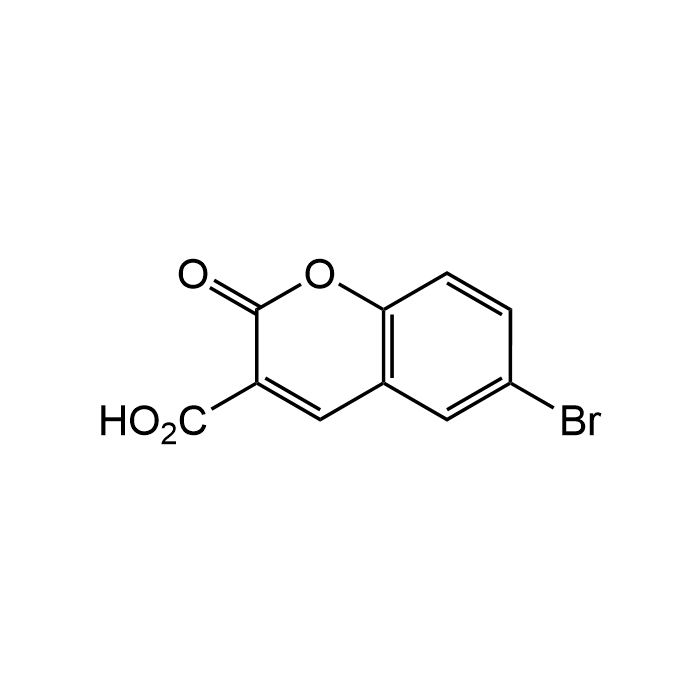
6-Bromo-3-carboxycoumarin
As low as
84
CHF
CHF 84.00
In stock
Only %1 left
CDX-B0557-G0055 gCHF 84.00
CDX-B0557-G02525 gCHF 290.00
NEW


Specifications / Handling
| Product Details | |
|---|---|
| Synonyms | UBP 608; 6-Bromo-2-oxo-2H-chromene-3-carboxylic acid; 6-Bromocoumarin-3-carboxylic acid |
| Product Type | Chemical |
| Properties | |
| Formula | C10H5BrO4 |
| MW | 269.05 |
| CAS | 2199-87-3 |
| Source/Host Chemicals | Synthetic |
| Purity Chemicals | ≥98% (HPLC) |
| Appearance | White to beige powder. |
| Solubility | Soluble in DMSO (10mg/ml). |
| Identity | Determined by 1H-NMR. |
| Declaration | Manufactured by Chemodex. |
| Other Product Data |
Click here for Original Manufacturer Product Datasheet |
| InChi Key | XFQHPAXNKDYMOX-UHFFFAOYSA-N |
| Smiles | O=C(O)C1=CC=2C=C(Br)C=CC2OC1=O |
| Shipping and Handling | |
| Shipping | AMBIENT |
| Short Term Storage | +20°C |
| Long Term Storage | +20°C |
| Handling Advice | Protect from light and moisture. |
| Use/Stability | Stable for at least 2 years after receipt when stored at RT. |
| Documents | |
| Product Specification Sheet | |
| Datasheet |
 Download PDF Download PDF |
Scientific Background Information
Product Description
6-Bromocoumarin-3-carboxylic acid (UBP608) is a halogenated coumarin derivative used as a versatile intermediate in organic synthesis and chemical research. Its bromine substituent and carboxylic acid functionality provide multiple reactive sites for further derivatization, making it valuable in the preparation of fluorescent probes, bioactive molecules, and specialty materials. This compound is commonly applied in medicinal chemistry, dye chemistry, and coumarin-based scaffold development, and it has also attracted interest in biological research as a potential inhibitor scaffold. UBP608 was described as a NMDA receptor family allosteric modulator that selectively inhibits GluN1/GluN2A receptors with a 23-fold selectivity compared to GluN1/GluN2D receptors.
Product-specific References
(1) R.H. Goodwin, et al.; Arch. Biochem. Biophys. 36, 442 (1952) | (2) P. Bassignana & C. Cogrossi; Tetrahedron 20, 2859 (1964) | (3) D.W. Wolan, et al.; Science 326, 853 (2009) | (4) B.M. Costa, et al.; J. Pharmacol. Exp. Ther. 335, 614 (2010) | (5) M.W. Irvine, et al.; Neurochem. Int. 61, 593 (2012) | (6) F. Yilmaz & E. Mentese; J. Chem. Res. 41, 4 (2017) | (7) O.J. Jesumoroti, et al.; MedChemComm 10, 80 (2019) | (8) S. Garcia, et al.; Molecules 25, 5134 (2020)