Cookie Policy: This site uses cookies to improve your experience. You can find out more about our use of cookies in our Privacy Policy. By continuing to browse this site you agree to our use of cookies.

Chemodex
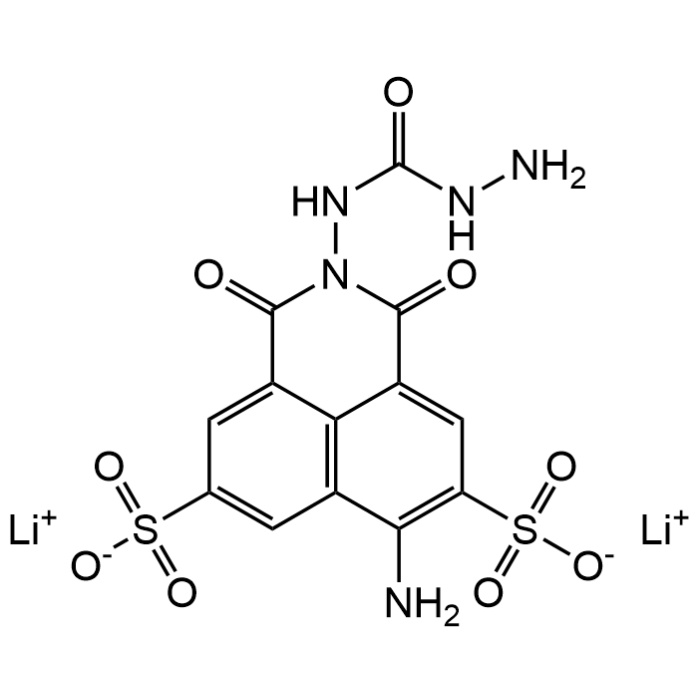
Lucifer Yellow CH dilithium salt
As low as
168
CHF
CHF 168.00
In stock
Only %1 left
CDX-L0007-M02525 mgCHF 168.00
CDX-L0007-M100100 mgCHF 503.00
CDX-L0007-M250250 mgCHF 1’005.00


Specifications / Handling
| Product Details | |
|---|---|
| Synonyms | Lucifer Yellow carbohydrazide; 6-Amino-2,3-dihydro-1,3-dioxo-2-hydrazinocarbonylamino-1H-benz[d,e]isoquinoline-5,8-disulfonic acid dilithium salt |
| Product Type | Chemical |
| Properties | |
| Formula | C13H9Li2N5O9S2 |
| MW | 457.25 |
| CAS | 67769-47-5 |
| Source/Host Chemicals | Synthetic |
| Purity Chemicals | ≥98% (NMR) |
| Appearance | Faint orange to orange powder. |
| Solubility | Soluble in water (1mg/ml). |
| Identity | Determined by 1H-NMR. |
| Declaration | Manufactured by Chemodex. |
| Other Product Data |
Click here for Original Manufacturer Product Datasheet |
| InChi Key | RPKCZJYDUKVMGF-UHFFFAOYSA-L |
| Smiles | [Li+].[Li+].NNC(=O)NN1C(=O)c2cc(cc3c(N)c(cc(C1=O)c23)S([O-])(=O)=O)S([O-])(=O)=O |
| Shipping and Handling | |
| Shipping | AMBIENT |
| Short Term Storage | +20°C |
| Long Term Storage | +4°C |
| Handling Advice | Protect from light and moisture. |
| Use/Stability | Stable for at least 2 years after receipt when stored at +4°C. |
| Documents | |
| Product Specification Sheet | |
| Datasheet |
 Download PDF Download PDF |
Scientific Background Information
Product Description
Lucifer Yellow CH dilithium salt is a fluorescent, water-soluble probe that contains a free hydrazido group that reacts with aliphatic aldehydes at room temperature. It is widely used as a tracer in cell biology, neurobiology and physiology research. Owing to its strong fluorescence, high photostability, and low membrane permeability, it is particularly well suited for monitoring cell morphology, intracellular diffusion, and intercellular communication. Lucifer Yellow CH is frequently employed as a biological tracer to monitor the branching pattern and regeneration of neurons, a marker for gap junctional communication, endocytosis, cell viability, and selective ablation of cells following aldehyde fixation. Spectral Data: λEx=430nm; λEm=540nm (in water).
Product-specific References
[1] W.W. Stewart; Cell 14, 741 (1978) | [2] W.W. Stewart; Nature 292, 17 (1981) | [3] G. Sczakiel, et al.; Anal. Biochem. 181, 309 (1989) | [4] R.A. Galuske, et al.; J. Histoch. Cytochem. 41, 1043 (1993) | [5] D. Luensmann, et al.; Curr. Eye Res. 34, 683 (2009) | [6] M. Hanani; J. Cell. Mol. Med. 16, 22 (2012) | [7] A.S. Kristoffersen, et al.; J. Fluoresc. 24, 1015 (2014) | [8] B. Qi, et al.; J. Exp. Clin. Cancer Res. 35, 161 (2016)