Cookie Policy: This site uses cookies to improve your experience. You can find out more about our use of cookies in our Privacy Policy. By continuing to browse this site you agree to our use of cookies.

Chemodex
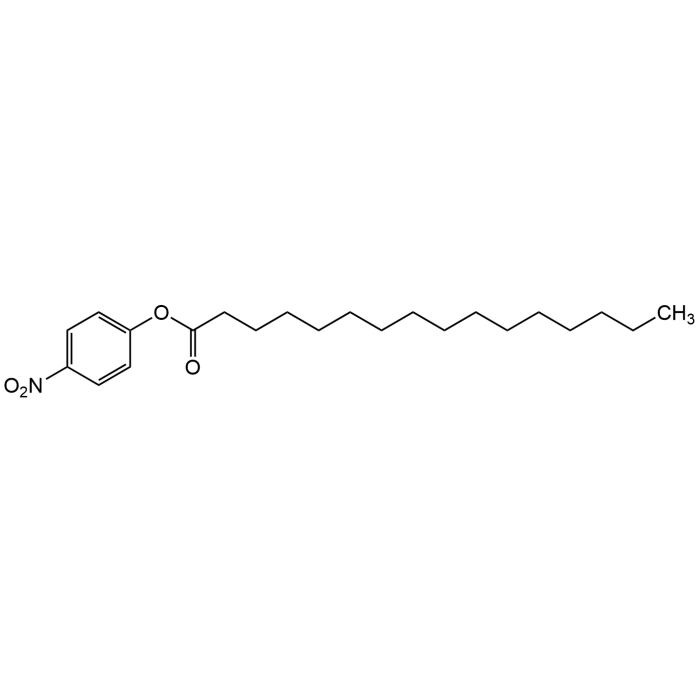
4-Nitrophenyl palmitate
As low as
116
CHF
CHF 116.00
In stock
Only %1 left
CDX-N0187-G0055 gCHF 116.00
NEW


Specifications / Handling
| Product Details | |
|---|---|
| Synonyms | 4-NPP; p-Nitrophenyl palmitate; 4-Nitrophenyl hexadecanoate; p-Nitrophenyl hexadecanoate; 4-Nitrophenyl ester hexadecanoic acid; |
| Product Type | Chemical |
| Properties | |
| Formula | C22H35NO4 |
| MW | 377.52 |
| CAS | 1492-30-4 |
| Source/Host Chemicals | Synthetic |
| Purity Chemicals | ≥98% (TLC) |
| Appearance | Powder. |
| Solubility | Soluble in chloroform (100mg/ml). |
| Identity | Determined by 1H-NMR. |
| Declaration | Manufactured by Chemodex. |
| Other Product Data |
Click here for Original Manufacturer Product Datasheet |
| InChi Key | LVZSQWIWCANHPF-UHFFFAOYSA-N |
| Smiles | O=C(OC1=CC=C(C=C1)N(=O)=O)CCCCCCCCCCCCCCC |
| Shipping and Handling | |
| Shipping | AMBIENT |
| Short Term Storage | +4°C |
| Long Term Storage | -20°C |
| Handling Advice | Protect from light and moisture. |
| Use/Stability | Stable for at least 2 years after receipt when stored at -20°C. |
| Documents | |
| Product Specification Sheet | |
| Datasheet |
 Download PDF Download PDF |
Scientific Background Information
Product Description
4-Nitrophenyl palmitate is a chromogenic long-chain fatty acid ester substrate widely used in enzymology and biochemical research for the characterization of lipase activity (less esterase activity). Upon enzymatic hydrolysis, it releases 4-nitrophenol, which can be converted to p-nitrophenoxide under alkaline conditions and quantified spectrophotometrically by monitoring its absorbance at approximately 405 nm. Due to its hydrophobic palmitate chain, 4-nitrophenyl palmitate is particularly suitable for studying enzymes involved in the hydrolysis of long-chain lipid substrates, including microbial, pancreatic, and recombinant lipases. The cell-bound lipase has preference for 4-nitrophenyl palmitate as substrate than the extracellular lipase.
Product-specific References
(1) R.A. Burdette & D.M. Quinn; J. Biol. Chem. 261, 12016 (1986) | (2) N. Gupta, et al.; Anal. Biochem. 311, 98 (2002) | (3) P. Wei, et al.; Arch. Microbiol. 191, 233 (2009) | (4) W. Juntachai, et al.; Microbiol. 157, 3492 (2011) | (5) Z. Hrydziuszko, et al.; Acta Biochim. Pol. 61, 1 (2014) | (6) P. Ganasen, et al.; Bioprocess. Biosyst. Eng. 37, 2353 (2014) | (7) J. Guo, et al.; Enzyme Microb. Technol. 71, 8 (2015) | (8) L. Lam & M.A. Ilies; Int. J. Mol. Sci. 23, 1262 (2022)