Cookie Policy: This site uses cookies to improve your experience. You can find out more about our use of cookies in our Privacy Policy. By continuing to browse this site you agree to our use of cookies.

Chemodex
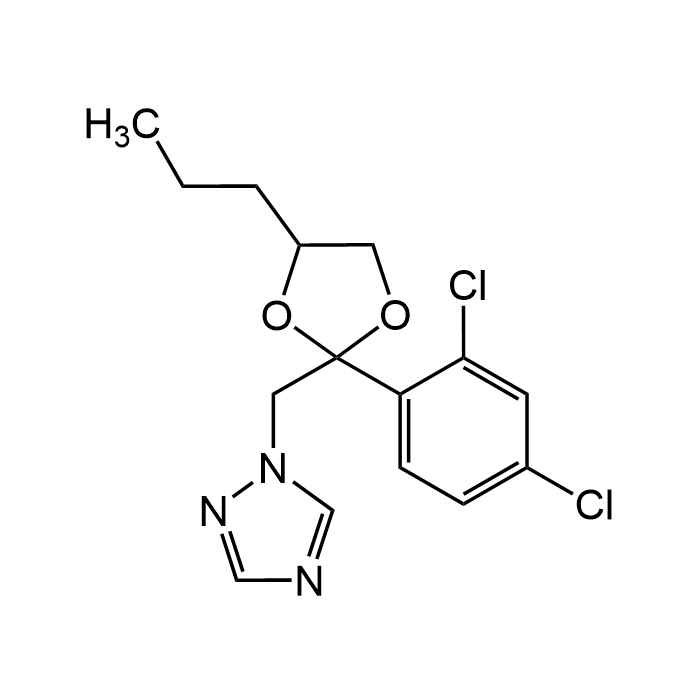
Propiconazole
As low as
CHF 90.00
In stock
Only %1 left
CDX-P0413-M250250 mgCHF 90.00


Specifications / Handling
| Product Details | |
|---|---|
| Synonyms | PPZ; CGA 64250; CGD 92710F; Proconazole; Microban S 2140 |
| Product Type | Chemical |
| Properties | |
| Formula | C15H17Cl2N3O2 |
| MW | 342.22 |
| CAS | 60207-90-1 |
| RTECS | XZ4620000 |
| Source/Host Chemicals | Synthetic |
| Purity Chemicals | ≥95% (NMR) |
| Appearance | Yellow to light brown semi-solid. |
| Solubility | Soluble in DMSO (20mg/ml), DMF, ethanol or acentonitrile. |
| Identity | Determined by 1H-NMR. |
| Declaration | Manufactured by Chemodex. |
| Other Product Data |
Click here for Original Manufacturer Product Datasheet |
| InChi Key | STJLVHWMYQXCPB-UHFFFAOYSA-N |
| Smiles | ClC1=CC(Cl)=CC=C1C2(CN3N=CN=C3)OC(CCC)CO2 |
| Shipping and Handling | |
| Shipping | AMBIENT |
| Short Term Storage | +20°C |
| Long Term Storage | +4°C |
| Handling Advice | Protect from light and moisture. |
| Use/Stability | Stable for at least 2 years after receipt when stored at +4°C. |
| Documents | |
| Product Specification Sheet | |
| Datasheet |
 Download PDF |
Scientific Background Information
Product Description
Propiconazole is a broad-spectrum triazole fungicide that inhibits ergosterol biosynthesis via the demethylation of C-14, leading to fungal cell membrane disruption. Formulations containing propiconazole have been used in the control of fungi in agriculture. It inhibits S. cerevisiae, but not rat liver, microsomal cytochrome P450. Propiconazole inhibits the growth of T. deformans and R. stolonifer, as well as A. niger, M. fructigena, S. nodorum, T. harzanium, R. solani, and S. rolfsii at concentrations ranging from 0.1 to 5 ppm. This compound can be used as analytical reference material. Propiconazole increases production of reactive oxygen species (ROS), the number of DNA mutations, and the incidence of tumor formation in mouse liver. Shown to activate PXR and disrupt hepatic metabolism in mice.
Product-specific References
(1) H. Vanden Bossche, te al.; Pestic. Sci. 15, 188 (1984) | (2) M. Sancholle, et al.; Pest. Biochem. Phys. 21, 31 (1984) | (3) J.A. Zarn, et al.; Environ. Health Perspect. 111, 255 (2003) | (4) M. Calonne, et al.; Chemosphere 87, 376 (2012) | (5) C.S. Mazur, et al., Toxicol. Lett. 232, 37 (2015) | (6) N.O. Costa, et al.; Toxicology 335, 55 (2015) | (7) J. Valades, et al.; Environ. Sci. Pollut. Res. Int. 26, 27808 (2019) | (8) B. Attema, et al; Arch. Toxicol. (Epub ahead of print) (2024)

You're in the Switzerland store. Not in Switzerland? Choose your country
You're in the Switzerland store (prices in CHF, shipping to Switzerland only). Ordering from another country? Please select it below.
Please note that not all products are available in every country store. Choose your country before starting the ordering process.
Country
Switzerland
 United Kingdom
 France
 Germany
 Austria
 Italy
 South Korea
 United States
 Argentina
 Australia
 Belgium
 Bosnia and Herzegovina
 Brazil
 Canada
 Chile
 China
 Colombia
 Cyprus
 Czech Republic
 Denmark
 Ecuador
 Egypt
 Estonia
 Finland
 Greece
 Hong Kong
 Hungary
 India
 Iran
 Iraq
 Ireland
 Israel
 Japan
 Latvia
 Lithuania
 Luxembourg
 Malaysia
 Mexico
 Netherlands
 New Zealand
 Norway
 Pakistan
 Peru
 Poland
 Portugal
 Romania
 Russia
 Singapore
 Slovakia
 Slovenia
 South Africa
 Spain
 Sweden
 Syria
 Taiwan
 Thailand
 Turkey
 Uruguay
 Venezuela
 Other Country
Switzerland
United Kingdom
France
Germany
Austria
Italy
South Korea
United States
Argentina
Australia
Belgium
Bosnia and Herzegovina
Brazil
Canada
Chile
China
Colombia
Cyprus
Czech Republic
Denmark
Ecuador
Egypt
Estonia
Finland
Greece
Hong Kong
Hungary
India
Iran
Iraq
Ireland
Israel
Japan
Latvia
Lithuania
Luxembourg
Malaysia
Mexico
Netherlands
New Zealand
Norway
Pakistan
Peru
Poland
Portugal
Romania
Russia
Singapore
Slovakia
Slovenia
South Africa
Spain
Sweden
Syria
Taiwan
Thailand
Turkey
Uruguay
Venezuela
Other Country
No country found