Cookie Policy: This site uses cookies to improve your experience. You can find out more about our use of cookies in our Privacy Policy. By continuing to browse this site you agree to our use of cookies.

RevMab
anti-IgG (rabbit), Goat Monoclonal (RMG03)
As low as
CHF 539.00
In stock
Only %1 left
REV-42-1030-00-C100100 µgCHF 539.00


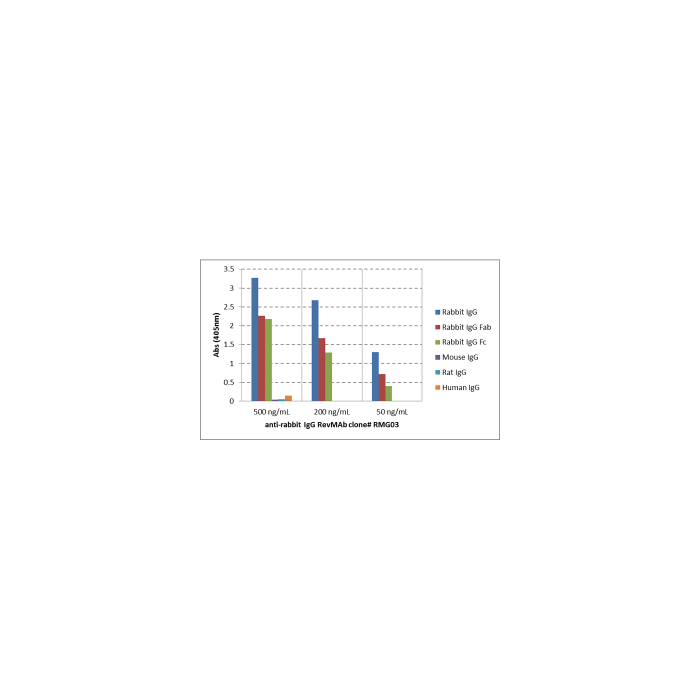
Figure 1: ELISA of IgGs from different species shows RMG03 reacts to rabbit IgG; no cross reactivity with human IgG
Specifications / Handling
| Product Details | |
|---|---|
| Synonyms | Immunoglobulin G |
| Product Type | Recombinant Antibody |
| Properties | |
| Clone | RMG03 |
| Isotype | Goat IgG |
| Source/Host | Goat |
| Immunogen/Antigen | Rabbit IgG. |
| Application |
ELISA: 0.01 µg/ml-0.5 µg/ml |
| Crossreactivity | Rabbit |
| Specificity | This antibody reacts to Rabbit IgG. No cross reactivity with human IgG, rat IgG, or mouse IgG. |
| Purity | Protein G purified. |
| Purity Detail | Protein G affinity purified from an animal origin-free culture supernatant. |
| Concentration | 1 mg/ml |
| Formulation | Liquid. 50% Glycerol/PBS with 1% BSA and 0.09% sodium azide. |
| Other Product Data |
Click here for Original Manufacturer Product Datasheet |
| Accession Number | N/A |
| Declaration | Manufactured by RevMab Biosciences. |
| Shipping and Handling | |
| Shipping | BLUE ICE |
| Long Term Storage | -20°C |
| Handling Advice | Avoid freeze/thaw cycles. |
| Use/Stability | Stable for at least 1 year after receipt when stored at -20°C. |
| Documents | |
| Product Specification Sheet | |
| Datasheet |
 Download PDF |
Scientific Background Information
Product Description
Immunoglobulin G (IgG), a monomer, is the predominant Ig class present in serum. Produced as part of the secondary immune response to an antigen, this class of immunoglobulin constitutes approximately 75% of total serum Ig. Rabbits only have one IgG subclass with two κ light chain types K1 and K2. Because of its relative abundance and excellent specificity toward antigens, IgG is the principle antibody used in immunological research and clinical diagnostics. The common rabbit IgG isotype has a molecular weight of 150 KD, with two heavy chains (about 50 KD each) and two light chains (about 25 KD each) under the non-reducing condition. This anti-rabbit secondary antibody has well-characterized specificity for rabbit IgG immunoglobulins and is useful in the detection, sorting or purification of its specified target. In general, secondary antibodies offer increased versatility enabling users to use many detection systems (e.g. HRP, AP, fluorescence). They can also provide greater sensitivity through signal amplification as multiple secondary antibodies can bind to a single primary antibody.