Cookie Policy: This site uses cookies to improve your experience. You can find out more about our use of cookies in our Privacy Policy. By continuing to browse this site you agree to our use of cookies.

SouthBayBio
K48-linked Tri-Ubiquitin (human) (rec.) (untagged)
As low as
228
CHF
CHF 228.00
In stock
Only %1 left
SBB-UP0171-C02525 µgCHF 228.00


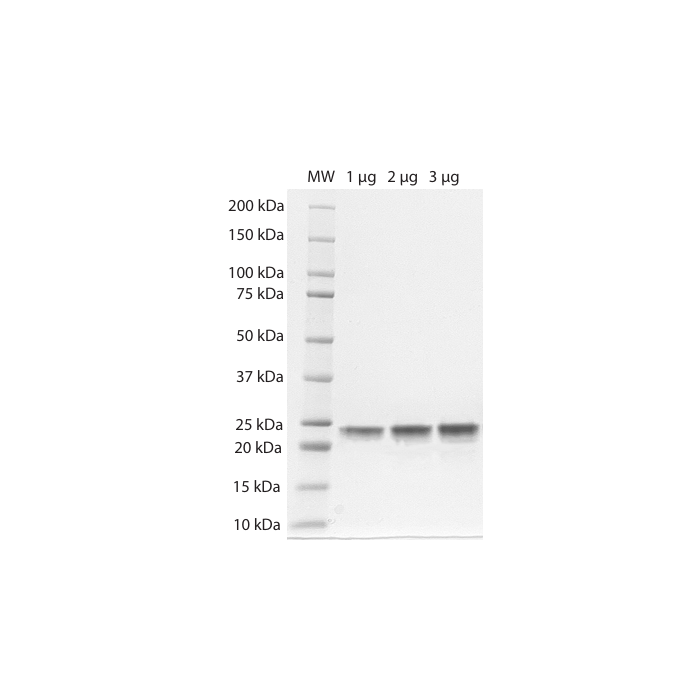
Figure 1: K48-Linked Tri-Ubiquitin SDS-PAGE. From left to right, increasing amounts of tri-ubiquitin were loaded onto a 10-20% SDS-PAGE gel, stained with Coomassie brillant blue. Purity is >98%.
Specifications / Handling
| Product Details | |
|---|---|
| Synonyms | Ub3 |
| Product Type | Protein |
| Properties | |
| Source/Host | E. coli |
| Sequence |
Three enzymatically conjugated human ubiquitin (aa1-76) (Accession Nr. P0CG47) covalently linked through an isopeptide bond at K48 residue of one ubiquitin molecule and the C-terminal glycine residue of another ubiquitin molecule and untagged. |
| Crossreactivity | Human |
| MW | ~26kDa |
| Purity | ≥98% (SDS-PAGE) |
| Concentration | Lot dependent. |
| Accession Number | P0CG47 |
| Formulation | Liquid. In PBS. |
| Other Product Data |
Click here for a Typical Lot-specific Product Datasheet from the Original Manufacturer Our product description may differ slightly from the original manufacturer's product datasheet. Note: Heating this product in SDS-PAGE buffer can lead to high apparent molecular weight banding or smearing on SDS-PAGE gels that is not representative of the product's purity. |
| Declaration | Manufactured by South Bay Bio. |
| Shipping and Handling | |
| Shipping | DRY ICE |
| Short Term Storage | -80°C |
| Long Term Storage | -80°C |
| Handling Advice | Aliquot to avoid freeze/thaw cycles. |
| Use/Stability | Stable for at least 1 year after receipt when stored at -80°C. |
| Documents | |
| Product Specification Sheet | |
| Datasheet |
 Download PDF Download PDF |
Scientific Background Information
Product Description
The array of cellular processes initiated and regulated by ubiquitin has been partially explained by the structural diversity of differently linked ubiquitin chains. In a ubiquitin chain, ubiquitin moieties can be conjugated through one of their lysine residues (K6, K11, K27, K29, K33, K48 and K63) or the N-terminal methionine residue (M1), offering countless possibilities to assemble a specific polymer. Ubiquitin molecules can also be modified by other post-translational modifications, including acetylation and phosphorylation, adding another layer of ubiquitin signal regulation and diversification. K48-polyubiquitin chains are the most abundant linkage in cells and thought to be the major signal for proteasome-mediated degradation. Quantitative MS analyses of intracellular ubiquitin linkages reveled K48-polyubiquitin linkages rapidly accumulate when cells are treated with the proteasome inhibitor MG132.
This protein is formed with wild-type human recombinant ubiquitin and linkage-specific enzymes. Ideal for investigating ubiquitin-binding proteins and as substrates for ubiquitin-specific isopeptidases. Reaction conditions will need to be optimized for each specific application. This K48-linked Triubiquitin is enzymatically conjugated, and purified via liquid chromatography.
Related Products