
AdipoGen Life Sciences
anti-FTO (mouse), mAb (FT62-6)


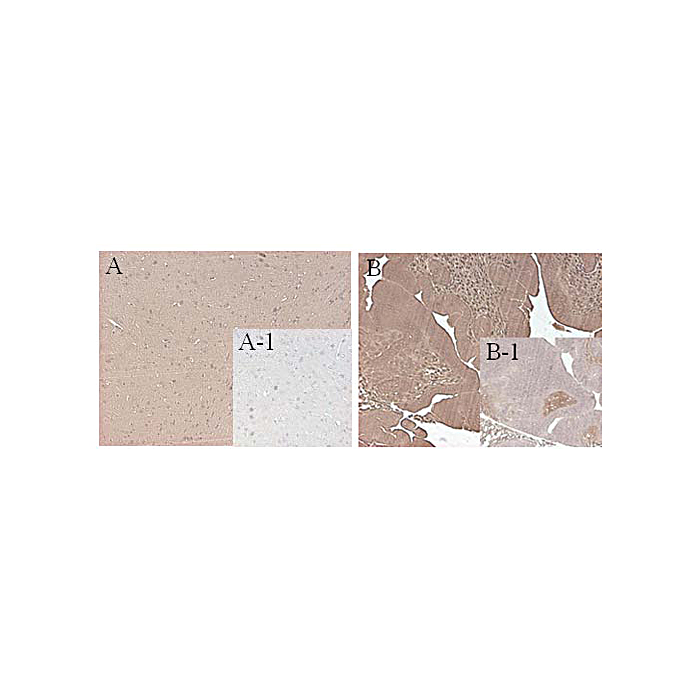
A. Immunoperoxidase staining of formalin-Fixed, paraffin-embedded mouse brain.
A-1. Isotype control, mouse brain.
B. Immunoperoxidase staining of formalin-Fixed, paraffin-embedded mouse uterus.
B-1. Isotype control, mouse uterus.
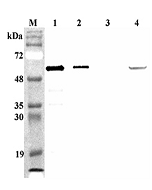
1. mFTO (His-tagged) recombinant control 50ng (AG-40A-127).
2. mFTO (His-tagged) 10μg.
3. mFTO (His-tagged) 5μg.
4. mFTO (His-tagged) 2.5μg.
5. mFTO (His-tagged) 1.25μg.
6. mFTO (His-tagged) 0.312μg.
7. mFTO (His-tagged) 0.156μg.
A)
1: Mouse kideny (200μg).
2: Mouse spleen (200μg).
3: Mouse heart (200μg).
4: Mouse liver (500μg).
5: Mouse stomach (200μg).
6: Mouse brain (300μg).
7: Mouse lung (200μg).
B)
1: Mouse FTO (10ng).
2: 3T3L1 (100μg).
Specifications / Handling
| Product Details | |
|---|---|
| Synonyms | Fat Mass and Obesity-associated Protein; FATSO |
| Product Type | Monoclonal Antibody |
| Properties | |
| Clone | FT62-6 |
| Isotype | Mouse IgG1κ |
| Immunogen/Antigen | Recombinant human FTO. |
| Application |
ELISA: (direct and indirect: 1:2’000-1:5’000) |
| Crossreactivity | Mouse |
| Specificity |
Recognizes mouse FTO. Weakly cross-reacts with human FTO. Does not cross-react with rat FTO. |
| Purity Detail | Protein G-affinity purified. |
| Concentration | 1mg/ml |
| Formulation | Liquid. 0.2μm-filtered solution in PBS, pH 7.4. Contains no preservatives. |
| Isotype Negative Control | |
| Shipping and Handling | |
| Shipping | BLUE ICE |
| Short Term Storage | +4°C |
| Long Term Storage | -20°C |
| Handling Advice |
After opening, prepare aliquots and store at -20°C. Avoid freeze/thaw cycles. |
| Use/Stability | Stable for at least 1 year after receipt when stored at -20°C. |
| Documents | |
| Safety Data Sheet |
 Download PDF |
| Product Specification Sheet | |
| Datasheet |
Download PDF |
Scientific Background Information
FTO (Fat mass-and obesity-associated gene) is the responsible gene for mouse ‘fused toes’ mutation. An association between FTO genotype and type 2 diabetes has been confirmed. The presence of the FTO rs9939609 A-allele was found to be positively correlated with other symptoms of the metabolic syndrome, including higher fasting insulin, glucose, triglycerides, and lower HDL-cholesterol.
-
 FTO (mouse) (rec.) (His) AG-40A-0127
-
 anti-FTO (mouse), pAb AG-25A-0089