Cookie Policy: This site uses cookies to improve your experience. You can find out more about our use of cookies in our Privacy Policy. By continuing to browse this site you agree to our use of cookies.

AdipoGen Life Sciences
Cystatin C (mouse) (monomer):Fc (silent) InVivoKine™
As low as
440
CHF
CHF 440.00
In stock
Only %1 left
AG-40B-0294-C05050 µgCHF 440.00


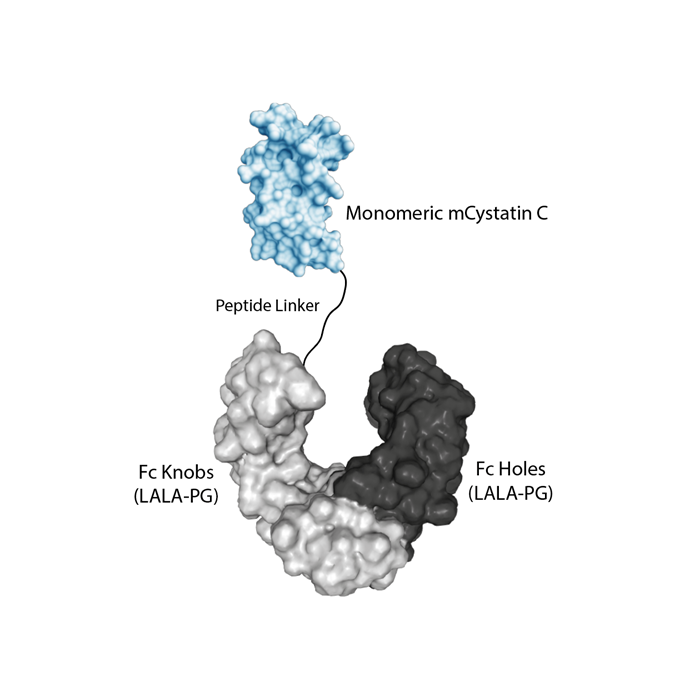
Figure 1: Protein structure of Cystatin C (monomer):Fc (silent) InVivoKine™ (Prod. No. AG-40B-0294).
Specifications / Handling
| Product Details | |
|---|---|
| Synonyms | Fc (LALA-PG)-KIH:Cystatin C (mouse); Fc (LALA-PG)-KIH:Cystatin 3 (mouse) |
| Product Type | Protein |
| Properties | |
| Source/Host | HEK 293 cells. Produced using animal component-free medium. |
| Sequence |
The extracellular domain of mouse Cystatin C (aa 21-140) is fused to the C-terminus of the Fc (LALA-PG) Knob region of human IgG1. Fc (LALA-PG) Knobs:Cystatin C (mouse) and Fc (LALA-PG) Holes form the Cystatin C (mouse) (monomer):Fc (silent) InVivoKine™ using the Knobs-into-Holes technology (see reference: J.B. Ridgway, et al.; Protein Eng. 9, 617 (1996)). |
| Crossreactivity |
Human Mouse |
| Specificity |
The Fc contains the mutations LALA-PG that abolish the interaction between the Fc and FcγRs and therefore Fc undesirable effects. The Fc (LALA-PG) is named Fc (silent). |
| MW | ~50kDa and 30 kDa (SDS-PAGE) |
| Purity | ≥95% (SDS-PAGE) |
| Endotoxin Content | <0.01 EU/μg purified protein (LAL test). |
| Concentration | 1mg/ml after reconstitution. |
| Reconstitution | Reconstitute with 50μl endotoxin-free water. |
| Accession Number | P21460 |
| Formulation | Lyophilized. Contains PBS |
| Protein Negative Control |
Fc (silent) InVivoKine™ (human) IgG1 Control (Prod. No. AG-35B-0018) |
| Other Product Data |
NCBI reference P21460 : Cystatin C (mouse) |
| Shipping and Handling | |
| Shipping | BLUE ICE |
| Short Term Storage | +4°C |
| Long Term Storage | -20°C |
| Handling Advice |
After reconstitution, prepare aliquots and store at -20°C. Avoid freeze/thaw cycles. Centrifuge lyophilized vial before opening and reconstitution. PBS containing at least 0.1% BSA should be used for further dilutions. |
| Use/Stability |
Stable for at least 6 months after receipt when stored at -20°C. Working aliquots are stable for up to 3 months when stored at -20°C. |
| Documents | |
| Product Specification Sheet | |
| Datasheet |
 Download PDF Download PDF |
Scientific Background Information
Product Description
Cystatin C (Cyst-C; Cystatin 3) is a member of the cystatin superfamily of cysteine protease inhibitors. Cystatin C is distributed in different organs and tissues and is associated with various immune responses to exogenous and endogenous antigens. The cystatin C gene is regulated by several factors during inflammation and infection. Cystatin C exerts its immunomodulatory functions by controlling the activity of cysteine proteases and other mechanisms.
For years, it has been observed that peripheral cancer inhibits amyloid pathology and rescues cognition in Alzheimer's disease. In a recent study, it was shown that Cystatin C secreted from peripheral tumor cells effectively reduces amyloid plaque burden and rescues cognition in mouse models of AD. Cystatin C, which acts as a ligand of triggering receptor expressed on myeloid cells 2 (TREM2), directly binds Aβ1-42 oligomers and activates TREM2 and enables microglia to phagocytose and degrade the pre-existing amyloid plaques.
The Cystatin C (mouse) (monomer):Fc (silent) InVivoKine™ is produced by using two different vectors, one encoding for the Fc Knobs (LALA-PG) (human):Cystatin C (mouse) sequence (synthesizing a protein of 50kDa) and one encoding for the Fc Holes (LALA-PG) sequence (synthesizing a protein of 30kDa). Both vectors, transfected into HEK 293 cells, produce both Fc molecules (Knobs-into-Holes technology; J.B. Ridgway, et al.; Protein Eng. 9, 617 (1996)) required for dimerization and for secretion of the final protein Cystatin C (mouse (monomer):Fc (silent) InVivoKine™. This Fc-KIH format allows our mouse Cystatin C protein to form a monomer Cystatin C fused to Fc, keeping its endogenous monomeric structure. The LALA-PG mutations inhibit binding to FcγRs and C1q while FcRn binding and Fc stability remain unaffected.
InVivoKines™ are a new generation of recombinant fusion proteins for immunotherapeutic, preclinical and translational in vivo research, developed and manufactured by AdipoGen Life Sciences.
Related Products
-
 IL-23 (mouse):Fc (silent) InVivoKine™ AG-40B-0248
 -
 IL-27 (mouse):Fc (silent) InVivoKine™ AG-40B-0249