Cookie Policy: This site uses cookies to improve your experience. You can find out more about our use of cookies in our Privacy Policy. By continuing to browse this site you agree to our use of cookies.

FGL1 & ERFE in Iron Regulation/Homeostasis
In mammalian systems, iron is essential for many biological processes, especially hemoglobin synthesis and oxygen transport. Erythropoiesis is finely coordinated with iron metabolism. Accordingly, anemia is the main consequence of iron deficiency. Iron availability is regulated by hepcidin, a liver-derived hormone that controls iron absorption and iron recycling by blocking the activity of the only known cellular iron exporter ferroportin. When hepcidin is high, ferroportin is degraded, reducing intestinal iron absorption and iron release from stores. When hepcidin is suppressed, more iron enters the circulation.
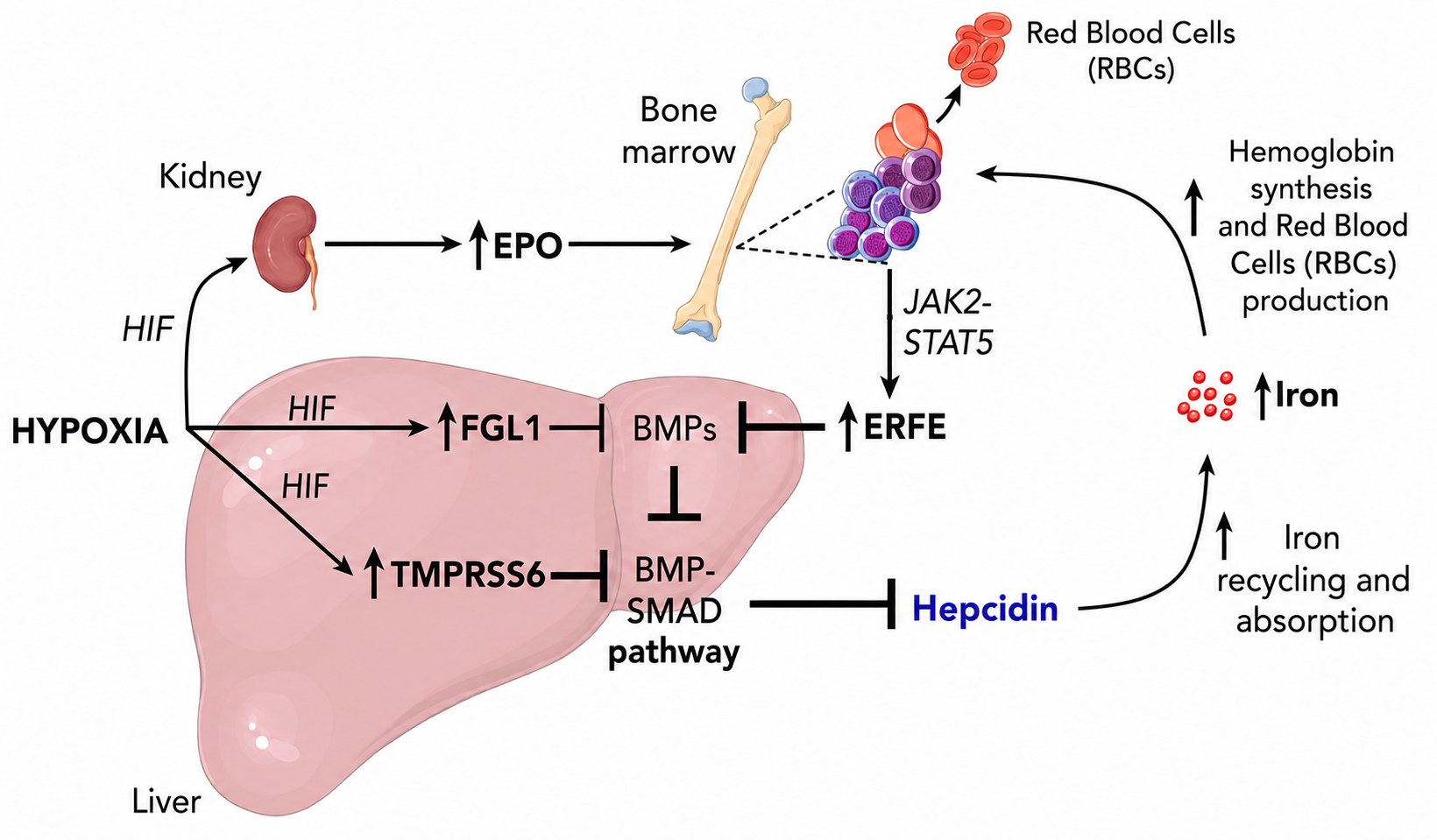
Figure 1
Iron signaling pathways under hypoxia. Adapted from L. Silvestri; Blood 143, 1208 (2024).
Iron Demand During Erythropoiesis
Red blood cell production is the body’s largest iron-consuming process. During blood loss, anemia recovery, or ineffective erythropoiesis, iron demand rises sharply. To meet this need, hepcidin must be rapidly suppressed so that iron can be mobilized for hemoglobin synthesis and erythrocyte maturation. This response is mainly regulated by erythroferrone (ERFE), fibrinogen-like protein 1 (FGL1), and TMPRSS6 (see Figure 1).
ERFE: The Early Erythroid Signal
ERFE is produced by erythroblasts in response to erythropoietin (EPO) and acts as an early signal of erythropoietic stress. It suppresses hepcidin by binding BMPs, especially BMP6, and inhibiting BMP-SMAD signaling. ERFE rises quickly after blood loss and provides the initial drop in hepcidin needed to release iron. However, ERFE alone does not fully explain long-term hepcidin suppression (see Figure 2 on the kinetics of ERFE and FGL1). For more information on AdipoGen Life Sciences ERFE ELISA Kits.
FGL1: A Newly Identified Hepcidin Suppressor
FGL1 is a hepatocyte-derived protein induced by hypoxia. Like ERFE, it suppresses hepcidin by antagonizing BMP6 and inhibiting BMP-SMAD signaling. Unlike ERFE, FGL1 rises later (see Figure 2) and remains elevated longer, making it important for sustained iron mobilization during prolonged erythropoietic stress. Its discovery shows that the liver actively contributes to iron regulation beyond hepcidin production. For more information on FGL1& LAG-3 Reagents.
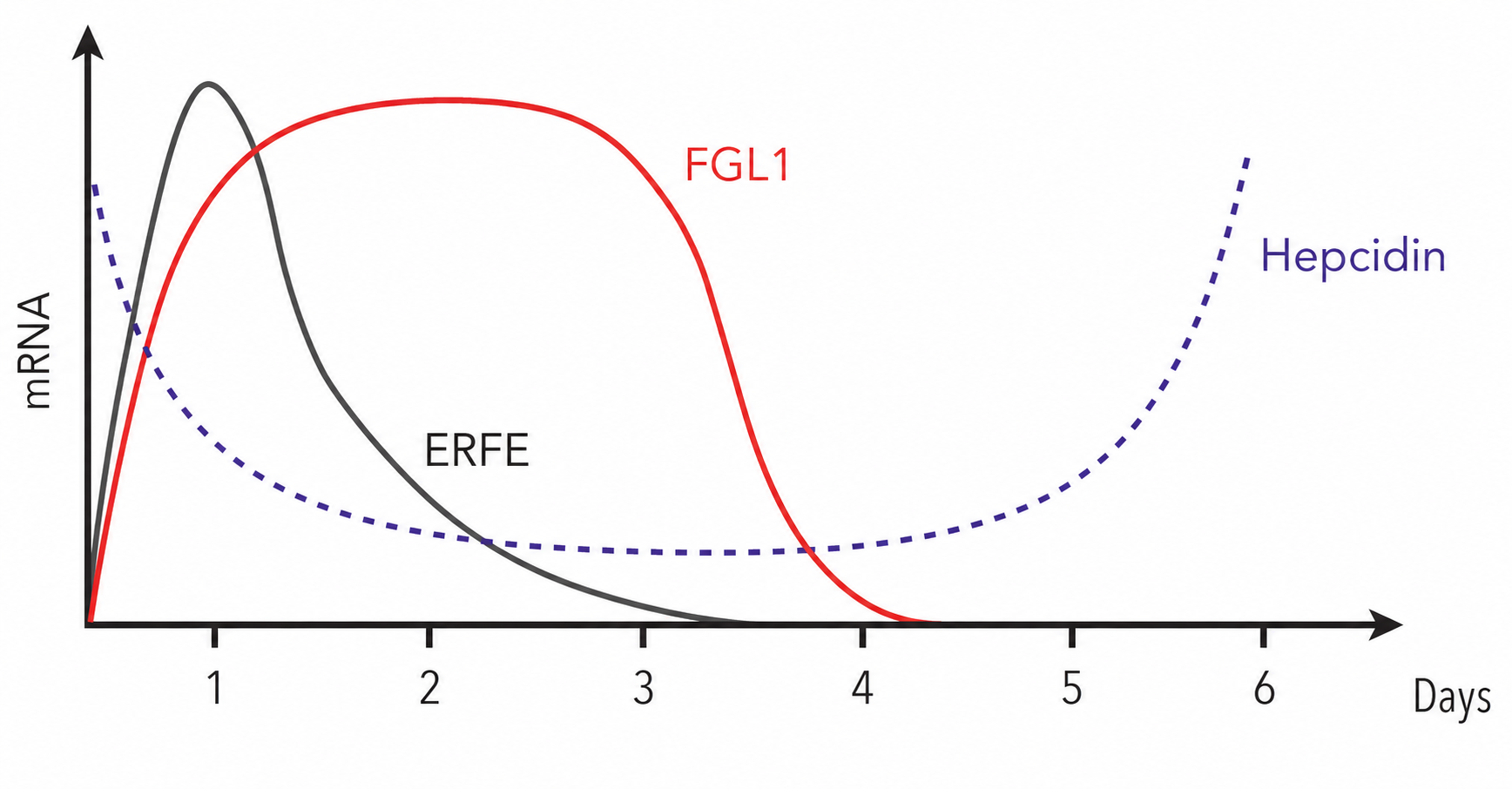
Figure 2
Kinetics of the key actors of Iron regulation Hepcidin, ERFE and FGL1. Adapted from L. Silvestri; Blood 143, 1208 (2024).
TMPRSS6: A Key Negative Regulator of Hepcidin
TMPRSS6 (matriptase-2) is a liver-expressed protease that also suppresses hepcidin. It reduces BMP-SMAD signaling by cleaving hemojuvelin, a co-receptor required for hepcidin induction. By lowering BMP signaling, TMPRSS6 helps maintain iron availability, especially during iron deficiency. Loss of TMPRSS6 function causes inappropriate hepcidin elevation and is linked to iron-refractory iron deficiency anemia (IRIDA).
A Coordinated Regulatory Network
Together, ERFE, FGL1, and TMPRSS6 form a coordinated system that suppresses hepcidin during stress erythropoiesis. Hypoxia via the hypoxia-inducible factor (HIF) stimulates EPO production in the kidney, which drives ERFE release from erythroid cells. At the same time, hypoxic signaling via HIF induces FGL1 and TMPRSS6 in the liver, which further dampens BMP-SMAD signaling. All three pathways converge to increase ferroportin activity and iron availability. This balance supports efficient iron recycling and red blood cell production. When disrupted, it can contribute to anemia of inflammation, IRIDA, β-thalassemia, and iron overload disorders. As key regulators of iron homeostasis and erythropoiesis, Hepcidin, ERFE, FGL1, and TMPRSS6 are important biomarkers and therapeutic targets. Understanding their interactions provides valuable insight into iron-related diseases and new treatment strategies.
Explore our portfolio of antibodies, recombinant proteins, ELISA kits, and research tools for studies in iron regulation, erythropoiesis, hypoxia signaling, and metabolic disease.
LIT: Ironing erythroid cells takes FLG1 and ERFE to tango: L. Silvestri; Blood 143, 1208 (2024) • The hepatokine FGL1 regulates hepcidin and iron metabolism during anemia in mice by antagonizing BMP signaling: U. Sardo, et al.; Blood 143, 1282 (2024) • Fibrinogen-like 1: A hepatokine linking liver physiology to hematology: J. Personnaz, et al.; HemaSphere 8, e115 (2024) • Evaluation of FGL1 as a hepatokine marker in iron deficiency: M. Saboor, et al.; Front. Nutr. 13, 1767385 (2026)
Biomarkers Assays for Iron Homeostasis Research
| Product Name | PID | Specificity/Sensitivity | Range | Samples |
| Erythroferrone (human) ELISA Kit | AG-45B-0014 | 270 pg/ml | 0.3125 - 20 ng/ml | Cell Culture Supernatant, Plasma, Serum |
| Erythroferrone (human) Matched Pair Detection Set | AG-46B-0012 | < 100 pg/ml | 0.078 - 5 ng/ml | Cell Culture Supernatant, Plasma, Serum |
| FGL1 (human) ELISA Kit | AG-45B-0022 | 1.8 pg/ml | 7.8 - 500 pg/ml | Cell Culture Supernatant, Plasma, Serum |
| FGL1 (human) Matched Pair Detection Set | AG-46B-0014 | < 5 pg/ml | 7.8 - 500 pg/ml | Cell Culture Supernatant, Plasma, Serum |
| Iron Colorimetric Assay Kit (Ferrozine Method) | JAI-CFE-005 | Specific to Fe2+ and Fe3+ | 5 - 1'000μg/dL | Cell Lysate, Plasma, Saliva, Serum, Tissue Supernatant, Urine |
| Iron Colorimetric Assay Kit (Nitroso-PSAP Method) | JAI-CFE-010 | Specific to Fe2+ and Fe3+ | 10 - 1'000μg/dL | Cell Lysate, Plasma, Saliva, Serum, Tissue Supernatant, Urine |
Biologically Active Proteins for Iron Homeostasis Research
| Product Name | PID | Source | Endotoxin | Species |
| BMP-2 (human) (rec.) (His) | CHI-HR-200BMP2 | E. coli | <0.1EU/µg | Human |
| BMP-2 (human):Fc (human) (rec.) (non-lytic) | CHI-HF-220BMP2 | CHO cells | <1EU/mg | Human |
| EPO (human):Fc (human) (rec.) (non-lytic) | CHI-HF-220EPO | CHO cells | <0.06EU/µg | Human |
| FGL1 (human) (rec.) (His) | AG-40B-0186 | HEK 293 cells | <0.01EU/µg | Human |
| Fc (human):FGL1 (human) (rec.) | AG-40B-0184 | HEK 293 cells | <0.01EU/µg | Human |
| Fc (human):FGL1 (mouse) (rec.) | AG-40B-0185 | HEK 293 cells | <0.01EU/µg | Mouse |
VALIDATED Antibodies for Iron Homeostasis Research
| Product Name | PID | Isotype | Applications | Species |
| FGL1 (human), Rabbit Monoclonal (RM502) | REV-31-1394-00 | Rabbit IgG | IHC, WB | Human |
| anti-Hif-1α (human), mAb (ANC10G3) | ANC-335-020 ANC-335-820 |
Mouse IgG1k | ELISA, FACS | Human |
| anti-HIF-1 (human), Rabbit Monoclonal (RM242) | REV-31-1121-00 | Rabbit IgG | IHC, WB | Human |
| anti-Phospho-Smad1 (Ser463/465) / Smad5 (Ser463/465) / Smad9 (Ser465/467), Rabbit Monoclonal (RM487) | REV-31-1379-00 | Rabbit IgG | WB | Human, Mouse, Rat |
| anti-Smad4 (human), Rabbit Monoclonal (RM277) | REV-31-1158-00 | Rabbit IgG | IHC, WB | Human |
| anti-SMAD4 (human), mAb (rec.) (PAS7-C7) | AG-27B-6331 | Human IgG1 | ELISA, ICC, PLA | Human |
|
More Information |
|
Downloadable Flyer |
|
Iron Regulation/Homeostasis Product Flyer In Progress - July 2026 |