Cookie Policy: This site uses cookies to improve your experience. You can find out more about our use of cookies in our Privacy Policy. By continuing to browse this site you agree to our use of cookies.

AdipoGen Life Sciences
anti-CD3 (human), mAb (TR66)
As low as
190
CHF
CHF 190.00
In stock
Only %1 left
AG-20B-0087-C100100 µgCHF 190.00
AG-20B-0087-C500500 µgCHF 760.00


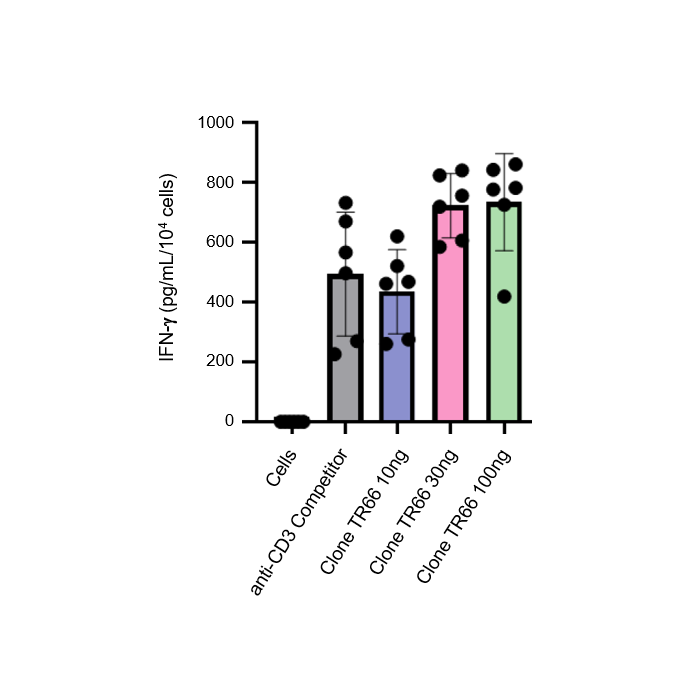
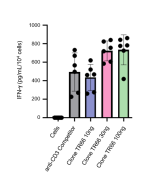
Figure 1: anti-CD3 (human), mAb (TR66) (Prod. No. AG-20B-0087) activates T cells. Methods: T cells (10E4 cells) are incubated with PBS (Cells) with an anti-CD3 from a Competitor at 30 ng/ml or with different concentrations of TR66 (#AG-20B-0087) as indicated in the figure. As a readout of T cell activation, IFN-γ is measured using an ELISA, and the concentration of IFN-γ per 10E4 T cells is shown. Courtesy of Markus Maeurer, Immunotherapy Cell Center Champalimaud Foundation, Portugal.
Specifications / Handling
| Product Details | |
|---|---|
| Synonyms | CD3ε; CD3e; T Cell Surface Glycoprotein CD3 epsilon Chain; T Cell Surface Antigen T3/Leu-4 epsilon Chain; T3E |
| Product Type | Monoclonal Antibody |
| Properties | |
| Clone | TR66 |
| Isotype | Mouse IgG1 |
| Source/Host | Purified from concentrated hybridoma tissue culture supernatant. |
| Immunogen/Antigen | Cloned human helper T cell line. |
| Application |
Flow Cytometry Immunocytochemistry Immunoprecipitation Western Blot Functional Application: Activates T cells in vivo and in vitro, together with a costimulatory signal and cytokine support. See also preservative-free version AG-20B-0087PF. |
| Crossreactivity | Human |
| Specificity |
Recognizes the ε-chain of CD3. |
| Purity | ≥95% (SDS-PAGE) |
| Purity Detail | Protein G-affinity purified. |
| Concentration | 1mg/ml |
| Formulation | Liquid. In PBS containing 0.02% sodium azide. |
| Isotype Negative Control | |
| Other Product Data |
Uniprot: CD3 (human) |
| Accession Number | P07766 |
| Shipping and Handling | |
| Shipping | BLUE ICE |
| Short Term Storage | +4°C |
| Long Term Storage | -20°C |
| Handling Advice |
After opening, prepare aliquots and store at -20°C. Avoid freeze/thaw cycles. |
| Use/Stability | Stable for at least 1 year after receipt when stored at -20°C. |
| Documents | |
| Product Specification Sheet | |
| Datasheet |
 Download PDF Download PDF |
Scientific Background Information
Product Description
CD3 is a multi-subunit protein complex expressed on the surface of T lymphocytes as part of the T cell receptor (TCR) complex. It plays a central role in T cell activation by transmitting signals from the TCR upon antigen recognition. Because of its consistent expression across all mature T cells, CD3 serves as a key pan-T cell marker in immunology research. Anti-CD3 antibodies are widely used to study T cell biology and immune signaling. They are used to identify and characterize T cells or activate T cells in vitro by crosslinking the TCR/CD3 complex, enabling functional assays of proliferation and cytokine production. The versatile applications make anti-CD3 antibodies essential tools in immunology, cancer immunotherapy research and studies of autoimmune diseases.
Product-specific References
- The use of hybrid hybridomas to target human cytotoxic T lymphocytes: A. Lanzavecchia & D. Scheidegger; Eur. J. Immunol. 17, 105 (1987) [PMID: 3102250]
- Efficiency of T cell triggering by anti-CD3 monoclonal antibodies (mAb) with potential usefulness in bispecific mAb generation: N. Jacobs, et al.; Cancer Immunol. Immunother. 44, 257 (1997) [PMC11037629]
- FLIP prevents apoptosis induced by death receptors but not by perforin/granzyme B, chemotherapeutic drugs, and gamma irradiation: T. Kataoka, et al.; J. Immunol. 161, 3936 (1998) [PMID: 9780161]
- T lymphocyte costimulation mediated by reorganization of membrane microdomains: A. Viola, et al.; Science 283, 680 (1999) [PMID: 9924026]
- Optimizing anti-CD3 affinity for effective T cell targeting against tumor cells: N. Bortoletto, et al; Eur. J. Immunol. 32, 3102 (2002) [PMID: 12385030]
- T cell fitness determined by signal strength: A.V. Gett, et al.; Nat. Immunol. 4, 355 (2003) [PMID: 12640450]
- Chemokine receptor expression identifies Pre-T helper (Th)1, Pre-Th2, and nonpolarized cells among human CD4+ central memory T cells: L. Rivino, et al.; J. Exp. Med. 200, 725 (2004) [PMC2211963]
- Coligation of the Hepatitis C Virus Receptor CD81 with CD28 Primes Naive T Lymphocytes to Acquire Type 2 Effector Function: A. Serra, et al.; J. Immunol. 181, 174 (2008) [PMID: 18566382]
- CD45RC isoform expression identifies functionally distinct T cell subsets differentially distributed between healthy individuals and AAV patients: L. Ordonez, et al.; PLoS One 4, e5287 (2009) [PMC2668071]
- Design, selection and optimization of an anti-TRAIL-R2/anti-CD3 bispecific antibody able to educate T cells to recognize and destroy cancer cells: A. Satta, et al.; MAbs 10, 1084 (2018) [PMC6204841]
- Tumor-induced senescent T cells promote the secretion of pro-inflammatory cytokines and angiogenic factors by human monocytes/macrophages through a mechanism that involves Tim-3 and CD40L: M.C. Ramello, et al.; Cell Death Dis. 5, e1507 (2014) [PMC4260722]
- ERK phosphorylation and miR-181a expression modulate activation of human memory TH17 cells: F. Mele, et al.; Nat. Commun. 6, 6431 (2015) [PMID: 25775432]
- The Interplay Between Neutrophils and CD8+ T Cells Improves Survival in Human Colorectal Cancer: V. Governa, et al.; Clin. Cancer Res. 23, 3847 (2017) [PMID: 28108544]
- An immunoregulatory and tissue-residency program modulated by c-MAF in human TH17 cells: D. Aschenbrenner, et al.; Nat. Immunol. 19, 1126 (2018) [PMC6402560]
- An optimized workflow for CRISPR-Cas9 deletion of surface and intracellular factors in primary human T lymphocytes: C. Leoni, et al.; PLoS One 16, e0247232 (2021) [PMC7891767]
- RFX transcription factors control a miR-150/PDAP1 axis that restrains the proliferation of human T cells: M. Chirichella, et al.; PLoS Biol. 20, e3001538 (2022) [PMC8865640]
- Proteomics of immune cells from liver tumors reveals immunotherapy targets: F.P. Canale, et al.; Cell Genom. 3, 100331 (2023) [PMC10300607]
- Activation of endogenous retroviruses and induction of viral mimicry by MEK1/2 inhibition in pancreatic cancer: A. Cortesi, et al.; Sci. Adv. 10, eadk5386 (2024) [PMC10971493]
- FCRL3 is an immunoregulatory receptor that restrains the activation of human memory T lymphocytes: N. Bianchi, et al.; J. Exp. Med. 223, e20242474 (2026) [PMC12524113]
Related Products
-
 anti-CD3 (mouse), mAb (145-2C11) (APC) ANC-703-060.
 -
anti-CD3 (mouse), mAb (145-2C11) (R-PE) ANC-703-050.
-
anti-CD3 (mouse), mAb (145-2C11) (FITC) ANC-703-040.
-
anti-CD3 (mouse), mAb (145-2C11) (Biotin) ANC-703-030.
-
anti-CD3 (mouse), mAb (145-2C11) ANC-703-020.
-
anti-CD28 (human), mAb (ANC28.1/5D10) ANC-177-020.
-
 anti-CD28 (human), Rabbit Monoclonal (RM404) REV-31-1290-00