Cookie Policy: This site uses cookies to improve your experience. You can find out more about our use of cookies in our Privacy Policy. By continuing to browse this site you agree to our use of cookies.

AdipoGen Life Sciences
BAFF, Soluble (mouse) ELISA Kit
As low as
640
CHF
CHF 640.00
In stock
Only %1 left
AG-45B-0033-KI0196 wellsCHF 640.00


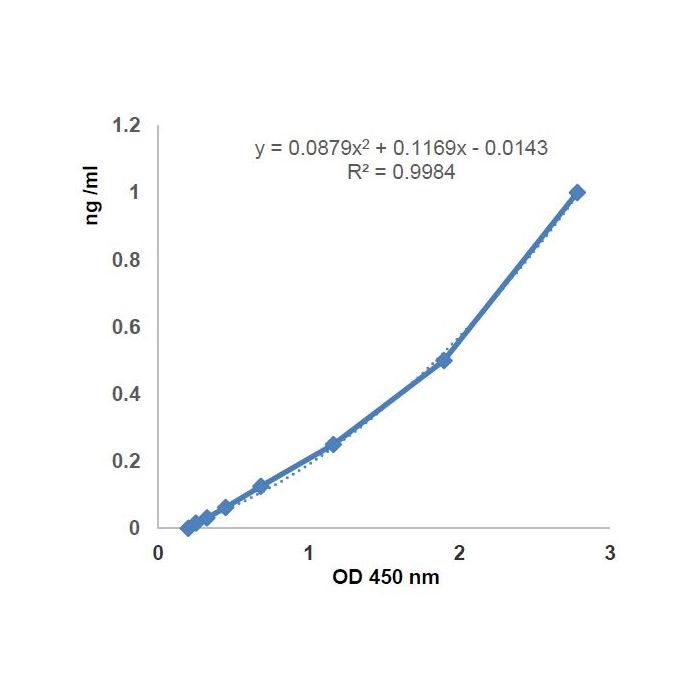
Figure 1: Standard curve
Specifications / Handling
| Product Details | |
|---|---|
| Synonyms | BlyS; B Cell Activating Factor, CD257, Tumor necrosis factor ligand superfamily member 13B; TNFSF13B |
| Product Type | Kit |
| Properties | |
| Application Set | Quantitative ELISA |
| Specificity |
Detects mouse BAFF. Does not detect human BAFF. |
| Crossreactivity | Mouse |
| Quantity |
1 x 96 wells |
| Sensitivity | 14 pg/ml |
| Range | 15.6 - 1000 pg/ml |
| Sample Type |
Cell Culture Supernatant Plasma Serum |
| Assay Type | Sandwich |
| Detection Type | Colorimetric |
| Accession Number | Q9WU72 |
| Shipping and Handling | |
| Shipping | BLUE ICE |
| Short Term Storage | +4°C |
| Long Term Storage | +4°C |
| Handling Advice |
After standard reconstitution, prepare aliquots and store at -20°C. Avoid freeze/thaw cycles. Plate and reagents should reach room temperature before use. |
| Use/Stability | 18 months after the day of manufacturing. See expiry date on ELISA Kit box. |
| Documents | |
| Manual |
 Download PDF Download PDF |
| Safety Data Sheet |
Download PDF |
| Product Specification Sheet | |
| Datasheet |
Download PDF |
Scientific Background Information
Product Description
BAFF (B cell activation factor of the TNF family, also known as BLyS or TALL1) is a key survival factor for peripheral B cells. BAFF is a homotrimeric type II transmembrane protein that can be proteolytically processed by furin to be released as soluble cytokine. Soluble BAFF adopts the classical trimeric form of the TNF-family ligand. However, BAFF has the unique property among the TNF-ligand to assemble as a 60-mer. BAFF is mainly produced by innate immune cells such as neutrophils, monocytes, macrophages, dendritic cells, follicular dendritic cells. T cells, activated B cells, some malignant B cells and also non-lymphoid cells like astrocytes, synoviocytes and epithelial cells can also produce BAFF. BAFF binds three distinct receptors (BAFF-R, TACI and BCMA) expressed predominantly on B cells, although activated T cells also express BAFF-R. BAFF is a master regulator of peripheral B cell survival, and together with IL-6, promotes Ig class-switching and plasma cell differentiation. Besides its major role in B cell biology, BAFF co-stimulates activated T cells. Deregulated expression of BAFF leads to autoimmune disorders in mice. In humans, elevated levels of soluble BAFF have been detected in the serum of patients with various autoimmune diseases, such as Sjoegren’s syndrome, Rheumatoid Arthritis (RA), Multiple sclerosis (MS) and Systemic Lupus Erythematosus (SLE). BAFF is also increased levels in some lymphoid cancers.
Related Products
-
 BAFF-R (human):Fc (human) (rec.) AG-40B-0027
 -
 anti-BAFF (human), mAb (1-35-1) AG-20B-0037
 -
anti-BAFF (human), mAb (2.81) AG-20B-0018