Cookie Policy: This site uses cookies to improve your experience. You can find out more about our use of cookies in our Privacy Policy. By continuing to browse this site you agree to our use of cookies.

PLXDC2 - Macrophage Reprogramming, Antitumor Immunity & Stem Cell Research
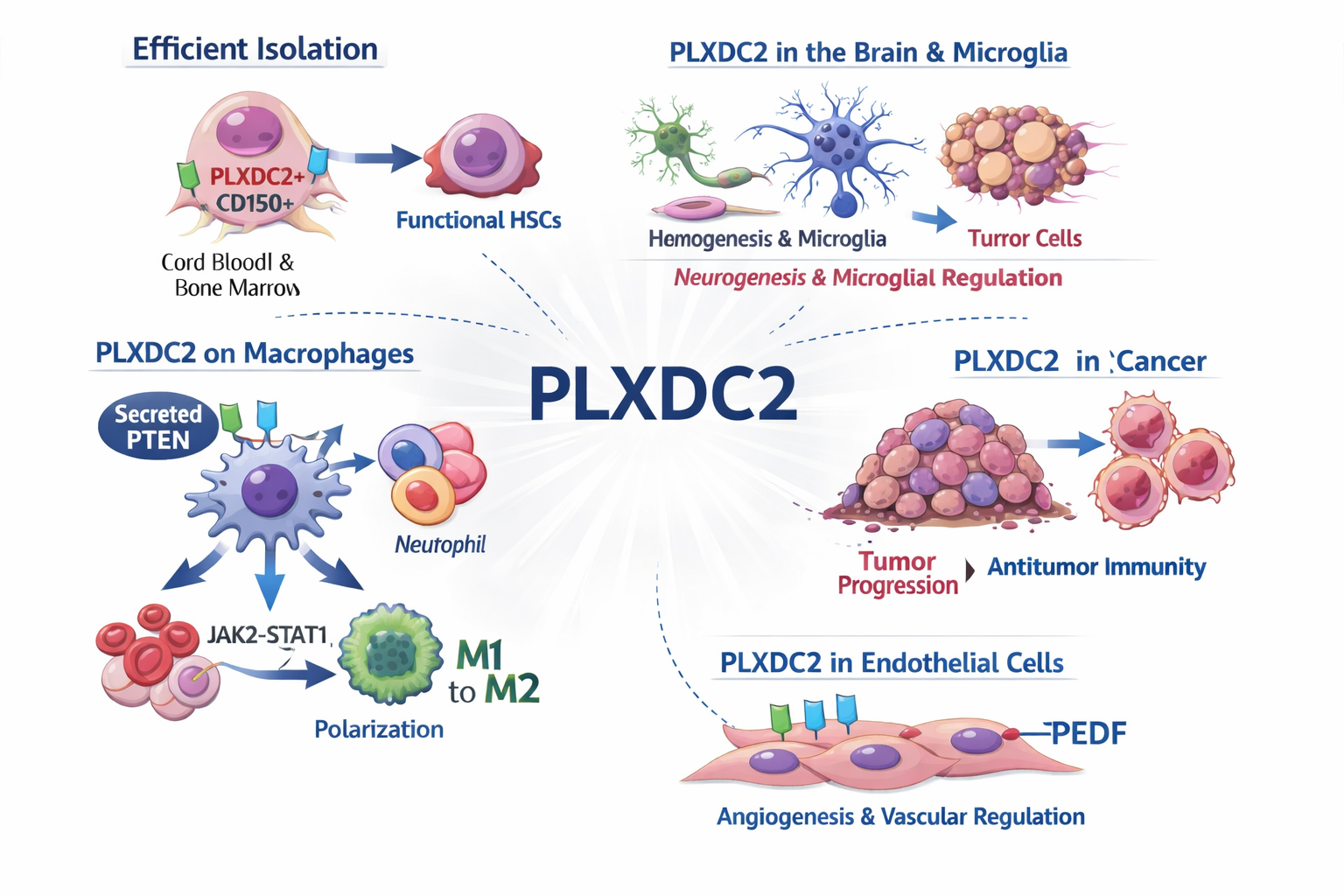
Plexin domain containing 2 (PLXDC2) is a nidogen/plexin homology transmembrane protein that is specifically expressed on the surface of macrophages but not to other immune cells such as neutrophils, T cells, or NK cells. PLXDC2 is also expressed at the surface of fibroblasts, neurons or endothelial cells. PLXDC2 has several functions: i) in the brain, it is involved in the proliferation and differentiation of neural progenitors during the development of the nervous system, it is also expressed on microglia and it helps to maintain microglial homeostatic state both in vitro and in vivo, and downregulation of Plxdc2 exacerbated microglial inflammatory response; ii) in the immune system, PLXDC2 on macrophages binds to secreted PTEN (phosphatase and tensin homolog) to sequentially activate JAK2-STAT1 signaling, which will reprogram macrophages from M1 to M2 type and drive antitumor immunity. Aberrant expression of PLXDC2 in different cancers has been reported. PLXDC2, together with its homolog PLXDC1, seems to be also the receptor for pigment epithelium-derived factor (PEDF) in endothelial cells.
Hematopoietic stem cells (HSCs) give rise to other blood cells. HSCs are defined by the capabilities of multi-lineage differentiation and long-term self-renewal, allowing the restoration of hematopoiesis after insults, such as infections or therapeutic ablation. Different markers (multi-antibody combination) are used for positive and negative selection (CD34+CD38-CD90+CD45RA-CD49f+) as a conventional protocol to isolate a population of cells that results in only ~10% functional HSCs when human cord blood is used as the starting material. So new markers are required to purify functional human or mouse HSCs in an easier and more efficient way.
A study from the lab of Prof. Toshio Kitamura (University of Tokyo, Japan) described in the Journal Communications Biology that the protein PLXDC2 is highly expressed in human and mouse HSCs derived from both cord blood and bone marrow, and PLXDC2 can be used as a new key marker to enrich both human and mouse HSCs using flow cytometry. The study shows that the use of both PLXDC2 and CD150 membrane proteins is sufficient for the isolation of functional HSCs without any additional markers. PLXDC2 in combination with CD150 is a new, very efficient, and easy protocol to highly purify mouse and human functional HSCs compared with the conventional multi-antibody combination (CD34+CD38-CD90+CD45RA-CD49f+) that results in only ~10% functional HSCs.
AdipoGen Life Sciences offers a unique panel of PLXDC2 research reagents, including Recombinant Proteins, Antibodies and ELISA Kits.
Literature References:
- Identification of a Binding Partner for the Endothelial Cell Surface Proteins TEM7 and TEM7R: A. Nanda, et al.; Cancer Res. 64, 8507 (2004)
- Plxdc2 Is a Mitogen for Neural Progenitors: S.F.C. Miller-Delaney, et al.; PLoS One 6, e14565 (2011)
- Identification of PLXDC1 and PLXDC2 as the transmembrane receptors for the multifunctional factor PEDF: G. Cheng, et al.; eLife 23, e05401 (2014)
- Plexin domain containing protein 2 is more expressed within the invasive area of human colorectal cancer tissues: Y. Hamada, et al.; Hum. Cell. 34, 1580 (2021)
- Secreted PTEN binds PLXDC2 on macrophages to drive antitumor immunity and tumor suppression: C. Zhang, et al.; Develop. Cell 59, 3072 (2025)
- Plexin Domain Containing 2, a Protein Specifically Expressed and Elevated in Human Pancreatic Cancer Tissue and Serum, Influences Cell Proliferation by Correlating with Cortactin: J. Tsuboi, et al.; Cancer Med. 14, e71459 (2025)
- Prospective isolation of mouse and human hematopoietic stem cells using PLXDC2: Y. Tanaka, et al.; Commun. Biol. 9, 20 (2025)
- Immunometabolism as a New Bimodal Therapeutic Concept in inflammatory Bowel Disease and ImmuneMediated Inflammatory Disorders: V. Solitano, et al.; Inflamm. Bowel Dis. 32, 803 (2026)
Biologically Active Recombinant PLXDC2 Proteins
| Product Name | PID | Source | Endotoxin | Species |
| PLXDC2 (human) (rec.) (His) | AG-40B-0275 | HEK 293 cells | <0.01EU/µg | Human, Mouse |
| PLXDC2 (mouse) (rec.) (His) | AG-40B-0271 | HEK 293 cells | <0.01EU/µg | Human, Mouse |
| NEW & Unique PLXDC2 (mouse):Fc (silent) InVivoKine™ Long-Lasting PLXDC2 construct for in vivo Studies! |
AG-40B-0270 | HEK 293 cells | <0.01EU/µg | Human, Mouse |
High Quality Flow Cytometry-Competent Antibodies and ELISA Kits for PLXDC2 Research
| Product Name | PID | Isotype | Applications | Species |
| anti-PLXDC2 (mouse), mAb (Bonny-1) | AG-20B-0086 | Mouse IgG2aκ | Flow Cytometry | Mouse |
| anti-PLXDC2 (mouse), mAb (Bonny-1) (Biotin) |
AG-20B-0086B |
Mouse IgG2aκ | Flow Cytometry | Mouse |
| anti-PLXDC2 (mouse), mAb (Bonny-1) (ATTO 647N) | AG-20B-0086TS | Mouse IgG2aκ | Flow Cytometry | Mouse |
| anti-PLXDC2, mAb (Bonny-2) |
AG-20B-0089 |
Mouse IgG1κ | Flow Cytometry, ELISA | Human, Mouse |
| Product Name | PID | Sensitivity | Range | Samples |
| NEW PLXDC2 (human) ELISA Kit |
AG-45B-0035 |
60 pg/ml | 0.078 to 5 ng/ml | Cell Culture Supernatant, Plasma, Serum |
| NEW PLXDC2 (mouse) ELISA Kit |
AG-45B-0036 |
50 pg/ml | 0.078 to 5 ng/ml | Cell Culture Supernatant, Plasma, Serum |