Cookie Policy: This site uses cookies to improve your experience. You can find out more about our use of cookies in our Privacy Policy. By continuing to browse this site you agree to our use of cookies.

SouthBayBio
PA28alpha (human) (rec.) (untagged)
As low as
345
CHF
CHF 345.00
In stock
Only %1 left
SBB-PP0080-C100100 µgCHF 345.00


Specifications / Handling
| Product Details | |
|---|---|
| Synonyms | Proteasome activator complex subunit 1; PSME1; IGUP I-5111; 11S regulator complex subunit alpha (REG-alpha); IFI5111 |
| Product Type | Protein |
| Properties | |
| Source/Host | E. coli |
| Crossreactivity | Human |
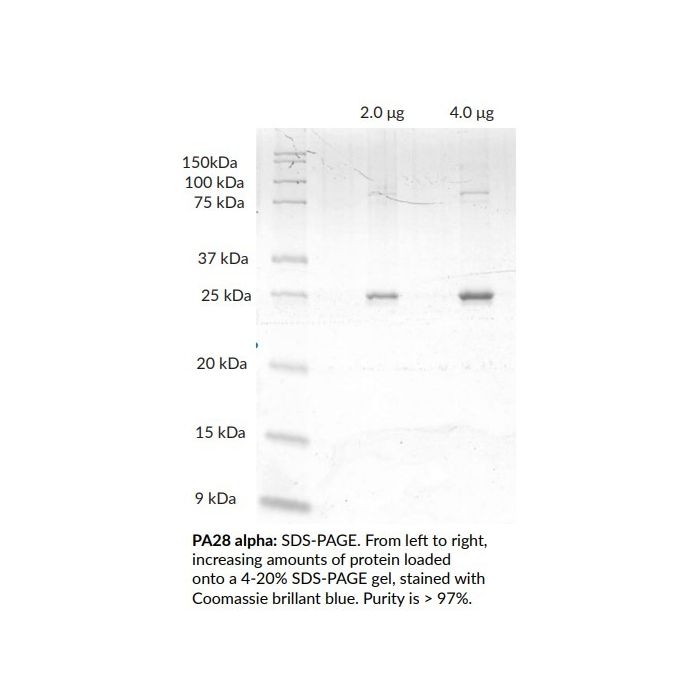
| MW | ~28.7kDa |
| Purity | ≥97% (SDS-PAGE) |
| Concentration | 70µm, 2.25mg/ml |
| Accession Number | Q06323 |
| Formulation | Liquid. In 50mM HEPES pH 8.0, 200mM NaCl, 0.5mM TCEP. |
| Other Product Data |
Click here for a Typical Lot-specific Product Datasheet from the Original Manufacturer |
| Declaration | Manufactured by South Bay Bio. |
| Shipping and Handling | |
| Shipping | DRY ICE |
| Short Term Storage | -80°C |
| Long Term Storage | -80°C |
| Handling Advice | Aliquot to avoid freeze/thaw cycles. |
| Use/Stability | Stable for at least 1 year after receipt when stored at -80°C. |
| Documents | |
| Product Specification Sheet | |
| Datasheet |
 Download PDF Download PDF |
Scientific Background Information
Product Description
Proteasomes are distributed throughout eukaryotic cells at a high concentration and cleave peptides in an ATP/ubiquitin-dependent process in a non-lysosomal pathway. An essential function of a modified proteasome, the immuno-proteasome, is the processing of class I MHC peptides. The immuno-proteasome contains an alternate regulator, referred to as the 11S regulator or PA28 that replaces the 19S regulator. PA28 alpha is implicated in immunoproteasome assembly and required for efficient antigen processing. The PA28 activator complex enhances the generation of class I binding peptides by altering the cleavage pattern of the proteasome. The PA28 complex is expressed constitutively in antigen-presenting cells, its expression is up-regulated by interferongamma, and it appears to be involved in the presentation of endogenous antigens by MHC class I molecules. The PA28 alpha protein was recombinantly expressed in E. coli.
Related Products
-
 20S Proteasome (human) (untagged) SBB-PP0005
 -
 20S Proteasome (mouse) (untagged) SBB-PP0047
 -
 20S Proteasome (rat) (untagged) SBB-PP0086