Cookie Policy: This site uses cookies to improve your experience. You can find out more about our use of cookies in our Privacy Policy. By continuing to browse this site you agree to our use of cookies.

Innaxon
SMA Universal with pH-Selector™
As low as
300
CHF
CHF 300.00
In stock
Only %1 left
IAX-700-205-M100100 mgCHF 300.00
IAX-700-205-M500500 mgCHF 725.00
NEW


Specifications / Handling
| Product Details | |
|---|---|
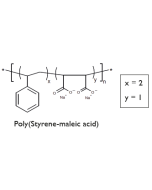
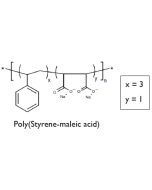
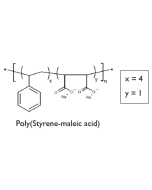
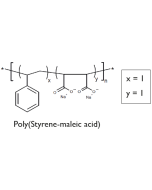
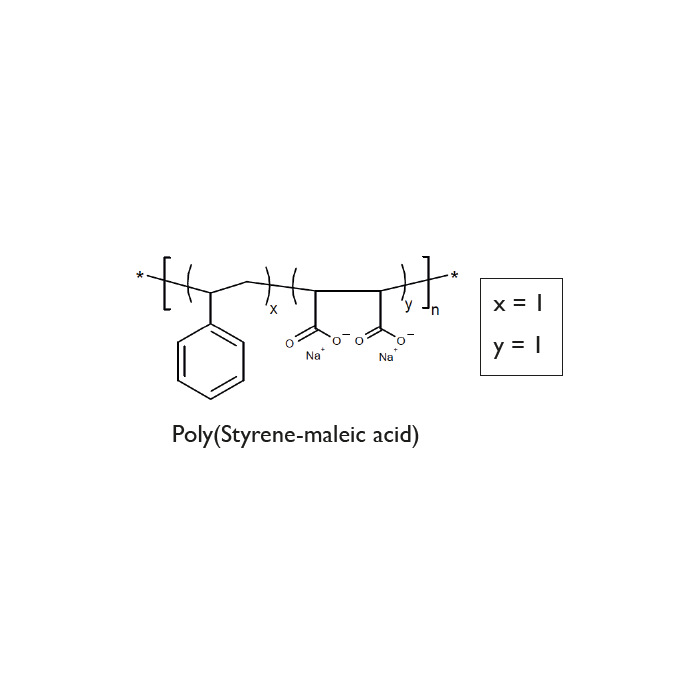
| Synonyms | SMALP; uSMA; Lipodisq™ Styrene:Maleic Acid Universal Copolymer with pH-Selector |
| Product Type | Chemical |
| Properties | |
| Formula |
C12H10O4Na2 |
| MW |
5,500 (based on weight) 2,100 (based on number) |
| CAS | 26762-29-8 |
| Purity Chemicals | ≥98% |
| Appearance | White powder. |
| Solubility | Soluble in water, and buffer solutions (pH 4.50-8.50) to allow the formulation of a proprietary, thermostable, aqueous lipid nanoparticle. |
| Reconstitution | Overcomes limitations using divalent ions or narrow, defined pH ranges usually an inherent property of P(SMA), which can cause P(SMA) precipitation or interfere with SMA-Lipid Particle formulation or stability. Compatible with Ca++ (10mM) or Mg++ (30mM). |
| Formulation | Lipodisq™ are nanosized lipid-based discoidal particles that can be manufactured with P(SMA)/ SMALP and lipids such as DMPC (14:0 PC) (DMPC: IAX-700-400) to incorporate hydrophobic, poorly water-soluble active compounds. |
| Declaration | Manufactured by Innaxon. |
| Other Product Data |
Click here for Original Manufacturer Product Datasheet: Our product description may differ slightly from the original manufacturer's product datasheet. Contains: 100mg size includes 0.5ml pH-Selector™ and 500mg size includes 2.5ml pH-Selector™ Lipodisq™ technology is covered by one or more of the following patents owned by Malvern Cosmeceutics Limited: AU2006253886, CA2611144, CN101184473B, EP1890675, GB2426703, IN261468, JP5142898, US8623414 and WO/2021/005340A1 pending. The purchaser is licensed under those patents to use these assemblies for the purpose of research and development only, but not for the purpose of delivery of agents for clinical use to humans or veterinary use to animals for therapeutic, diagnostic or prophylactic purposes, which uses are specifically prohibited. |
| Smiles | |
| Shipping and Handling | |
| Shipping | AMBIENT |
| Short Term Storage | +20°C |
| Long Term Storage | +20°C |
| Handling Advice |
Do not freeze. Keep sterile. Avoid skin and eye contact. |
| Use/Stability | Stable for at least 3 years after receipt when stored at +20°C. |
| Documents | |
| Product Specification Sheet | |
| Datasheet |
 Download PDF Download PDF |
Scientific Background Information
Product Description
- A nanoparticle (11-40nm) drug delivery system comprising a discoidal phospholipid bilayer membrane stabilized by a chaperone molecular annulus.
- Components are batch-tested for Lipodisq™ formation using buffer systems available, which are tested for nano-formulated drug analysis by Dynamic Light Scattering (DLS). These buffer solutions are endotoxin-tested and sterile.
- Lipodisq™ formation is highly efficient and shows a good safety profile, suitable for in vitro and in vivo (in experimental animals) investigations.
Enables membrane proteins (MP) to be reconstituted within phospholipid membrane mimics without the use of mediating detergent. Nanodiscs formed from SMA are also referred to as styrene maleic acid lipid particles (SMALP). SMA-lipid particles are formed by directly extracting membrane proteins either from native cellular membranes (giving native nanodiscs) or from an intermediary MP-reconstituted synthetic membrane system to ultimately form self-assembled discoidal nano-structures of a general diameter of 10-12 nm.
- uSMA requires only a single polymer grade to be used, avoids the need to select several SMA grades that each operate only over a narrow pH range.
- uSMA can be tailored to operate over a wide pH range 4.5-8.5 by simple addition of standard quantities of pH-Selector™
- uSMA is insensitive to presence of divalent cations, Ca2+(<10mM) and Mg2+ (<30mM), suitable for use with ion pores, ABC transporters and ion sensitive GPCR assemblies
- uSMA can be modified to form larger particles, reducing direct interactions between the polymer chaperone and membrane‑bound proteins
The ability of SMA to create monodisperse nanodiscs covering a range of particle sizes facilitates the reconstitution of oligomeric MPs and MP complexes for analysis by various methods including fluorescence microscopy, NMR and single-particle cryo-EM.
- As a starting point use a ratio of 2.5:1 (w/w) for P(SMA)/SMA polymer and phospholipid, such as 100mg P(SMA)/SMA polymer and 40mg DMPC. Prepare 5% (w/w) uSMA in deionized water.
- Adjust the solution with the corresponding volume of pH-Selector (see table) and confirm the pH.
- Prepare a 2% (w/w) aqueous phospholipid emulsion in deionized water. Incorporate hydrophobic drug candidate/peptides/transmembrane proteins (MP) at up to 0.2% (w/w)
- This mixture is stirred at temperatures above the phase transition temperature of the lipid (>24°C for DMPC), before aqueous P(SMA)/SMA polymer at 5% is added drop-wise until an approximate volume ratio of 1:1 is reached and the lipid emulsion clears.
- Alternatively, P(SMA)/SMA polymer solutions containing the pH selectorTM at the selected pH are mixed with native (cell or bacterial) membranes to form native nanodiscs.
- Stirring time, pH, selected buffer type and strength (e.g. HEPES, NaCl, TRIS or PBS with or w/o Ca++ and Mg++), pH-SelectorTM and temperature of the phospholipid emulsion containing the MP or active agent, need to be optimized.
- Purification of formed LipodisqTM can be achieved by ultracentrifugation at >100,000 x g to remove residual lipid and excess P(SMA)polymer or a size exclusion column (SEC) can be used.
Product-specific References
- Reconstitution of membrane proteins: a GPCR as an example: A.D. Goddard, et al.; Methods Enzymol. 556, 405 (2015)
- The styrene-maleic acid copolymer: a versatile tool in membrane research: J.M. Doerr, et al.; Eur. Biophys. J. 45, 3 (2016)
- From polymer chemistry to structural biology: The development of SMA and related amphipathic polymers for membrane protein extraction and solubilization: J.F. Bada Juarez, et al.; Chem. Phys. Lipids. 221, 167 (2019)
- Effects of charged lipids on the physicochemical and biological properties of lipid-styrene-maleic acid copolymer discoidal particles: M. Tanakaa, et al.; Biochim. Biophys. Acta. Biomembr. 1862, 183209 (2020)
- Physicochemical Characterization, Toxicity and In Vivo Biodistribution Studies of a Discoidal, Lipid-Based Drug Delivery Vehicle: Lipodisq Nanoparticles Containing Doxorubicin: M.L. Torgersen, et al.; J. Biomed. Nanotechnol. 16, 41 (2020)
- Understanding the Structural Pathways for Lipid Nanodisc Formation: How Styrene Maleic Acid Copolymers Induce Membrane Fracture and Disc Formation: V.A. Bjornestad, et al.; Langmuir 37, 6178 (2021)
- Applications of Synthetic Polymer Discoidal Lipid Nanoparticles to Biomedical Research: M. Tanaka; Chem. Pharm. Bull. 70, 507 (2022)
- Mechanisms of Formation, Structure, and Dynamics of Lipoprotein Discs Stabilized by Amphiphilic Copolymers: A Comprehensive Review: P.S. Orekhov, et al.; Nanomaterials 12, 361 (2022)
Related Products