Cookie Policy: This site uses cookies to improve your experience. You can find out more about our use of cookies in our Privacy Policy. By continuing to browse this site you agree to our use of cookies.

AdipoGen Life Sciences
IL-10 (mouse):Fc (mouse) (rec.) (non-lytic)
As low as
440
CHF
CHF 440.00
In stock
Only %1 left
AG-40B-0286-C05050 µgCHF 440.00



Specifications / Handling
| Product Details | |
|---|---|
| Synonyms | Interleukin-10; Cytokine Synthesis Inhibitory Factor; CSIF |
| Product Type | Protein |
| Properties | |
| Source/Host | CHO cells |
| Sequence |
The extracellular domain of mouse IL-10 (aa 19-178) is fused to the N-terminus of the Fc region of a mutant mouse IgG2a. |
| Crossreactivity | Mouse |
| Specificity |
Binds to mouse IL-10 receptor (IL-10R) complex. |
| Biological Activity |
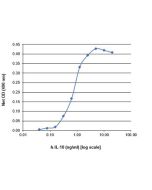
Inhibits mouse IL-6 secretion induced by LPS in RAW 264.7 cells. |
| Purity | ≥98% (SDS-PAGE) |
| Endotoxin Content | <0.02 EU/μg protein (LAL test). |
| Concentration | After reconstitution: 1mg/ml |
| Reconstitution | Reconstitute with 50μl endotoxin-free water. |
| Accession Number | P18893 |
| Formulation | Lyophilized. Contains PBS. |
| Protein Negative Control | |
| Other Product Data |
Non-lytic: Acts as a long lasting fusion protein which only binds to the receptor. Mutations to the complement (C1q) and FcgR I binding sites of the IgGs Fc fragment render the fusion proteins incapable of antibody directed cytotoxicity (ADCC) and complement directed cytotoxicity (CDC). |
| Shipping and Handling | |
| Shipping | BLUE ICE |
| Short Term Storage | +4°C |
| Long Term Storage | -20°C |
| Handling Advice |
Avoid freeze/thaw cycles. Centrifuge lyophilized vial before opening and reconstitution. |
| Use/Stability |
Stable for at least 1 year after receipt when stored at -20°C. Working aliquots are stable for up to 3 months when stored at -20°C. |
| Documents | |
| Product Specification Sheet | |
| Datasheet |
 Download PDF Download PDF |
Scientific Background Information
Product Description
Interleukin-10 (IL-10) is a homodimeric cytokine. Its functional form consists of two identical monomers, each composed of approximately 160 amino acids. These monomers are arranged in a noncovalent dimer, stabilized by hydrophobic and electrostatic interactions. This dimeric structure is essential for IL-10's ability to bind its receptor complex, which includes IL-10 receptor α (IL-10R1) and IL-10 receptor β (IL-10R2), to mediate its anti-inflammatory and immunoregulatory functions.
IL-10 is a cytokine with multiple, pleiotropic effects in immunoregulation and inflammation. It downregulates the expression of Th1 cytokines, MHC class II antigens, and co-stimulatory molecules on macrophages. It also enhances B-cell survival, proliferation, and antibody production. IL-10 can block NF-κB activity and is involved in the regulation of the JAK-STAT signaling pathway.
IL-10 is an immunosuppressive cytokine as it plays an important regulatory role in limiting excessive immune response to inflammation and in protection against autoimmune diseases. Through the downregulation of major histocompatibility complex (MHC-II), IL-10 blunts dendritic cell (DC) response to antigen stimulation, thus inhibiting the production of several stimulatory cytokines. IL-10 can enhance the survival of B cells and cytotoxic T cells, aiding in the immune response to certain viral infections. IL-10 also inhibits CD4+ T cells’ proliferation and function, thus contributing to an immunosuppressive tumor microenvironment.
Related Products
-
 IL-10 (mouse):Fc (silent) InVivoKine™ AG-40B-0287
 -
 IL-10 (human):Fc (silent) InVivoKine™ AG-40B-0265
 -
 IL-10 (human) ELISA Kit AG-45B-0029
 -
 IL-10 (human) (rec.) (His) CHI-HR-20010
 -
IL-10Rα (human):Fc (human) (rec.) CHI-HF-21010RA
-
IL-10 (human):Fc (human) (rec.) CHI-HF-21010
-
IL-10 (human) (rec.) (His) CHI-HF-20110