Cookie Policy: This site uses cookies to improve your experience. You can find out more about our use of cookies in our Privacy Policy. By continuing to browse this site you agree to our use of cookies.

Interleukin-9 Signaling in Tumor Immunity and T Cell Engineering
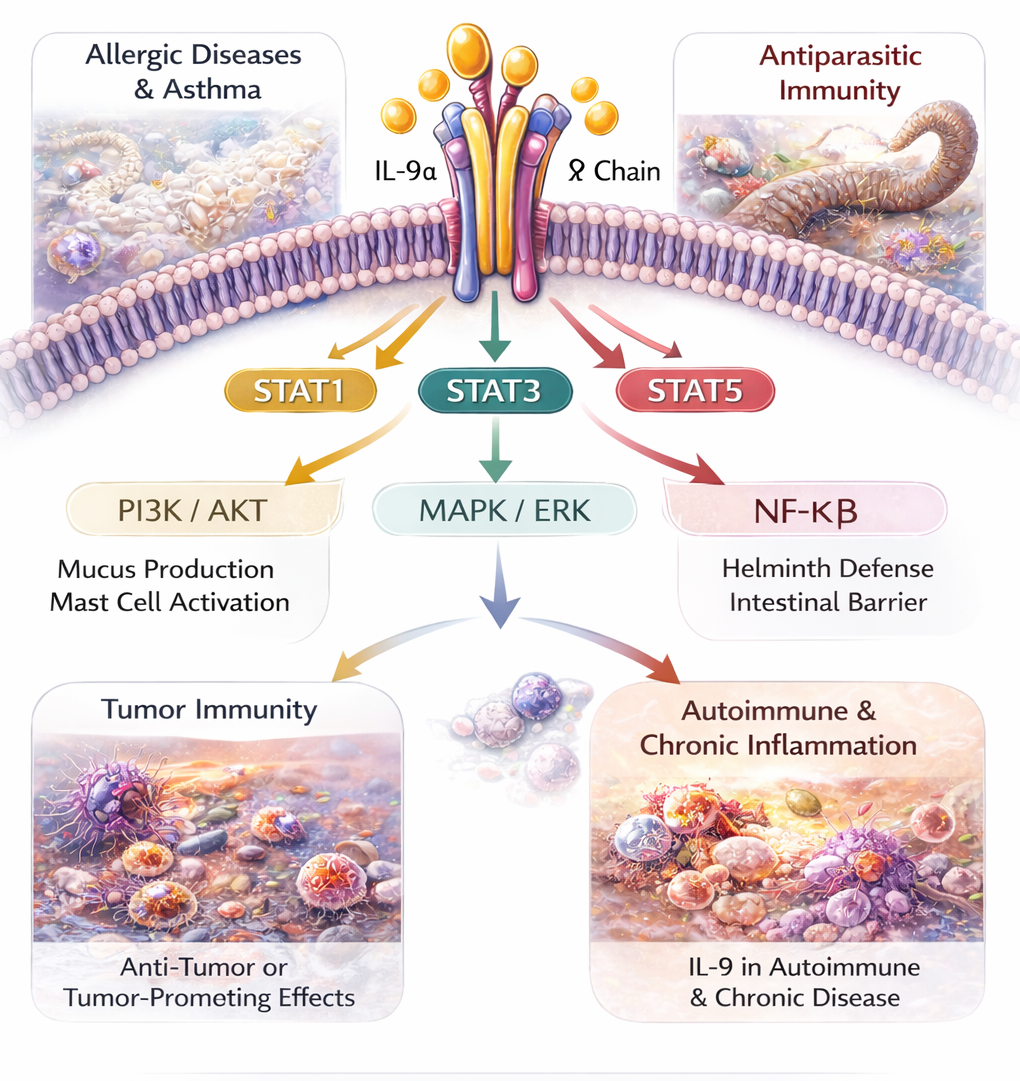
Interleukin-9 (IL-9) is a pleiotropic cytokine that plays a central role in immune regulation, inflammation, host defense, and tissue homeostasis. Originally characterized as a T cell and mast cell growth factor, IL-9 is now recognized as a multifunctional mediator produced primarily by T helper 9 (Th9) cells, as well as innate lymphoid cells (ILCs), mast cells, and regulatory T cell subsets. Through its broad cellular targets and diverse downstream signaling networks, IL-9 contributes to both protective immunity and pathological inflammation across multiple tissues. IL-9 exerts its biological effects through binding to the IL-9 receptor complex (IL-9Rα and the common γ-chain), activating canonical JAK1/JAK3-STAT signaling pathways, particularly STAT1, STAT3, and STAT5. These signaling cascades regulate gene programs involved in cell proliferation, survival, cytokine production, and immune-cell differentiation. IL-9 signaling also intersects with PI3K-AKT, MAPK/ERK, and NF-κB pathways, enabling context-dependent modulation of inflammatory and immune responses.
Functionally, IL-9 is involved in allergic inflammation, asthma, anti-parasitic immunity, and mucosal barrier protection. In the respiratory tract, IL-9 promotes mast cell accumulation, mucus production, eosinophilic inflammation, and airway hyperresponsiveness. Within the gastrointestinal system, IL-9 contributes to epithelial integrity and defense against helminth infections.
Emerging evidence also demonstrates important roles for IL-9 in tumor immunity, where IL-9R-producing immune cells can either enhance antitumor responses or support tumor-promoting inflammation depending on the microenvironment and cancer type.
Several cytokines of the γ-chain family, such as IL-2, IL-7, IL-9 and IL-15, function as T-cell growth factors. Most of them are used to fight cancers via CAR-T cells expressing their respective receptor or by injecting them directly in vivo. However, the use of these cytokines poses challenges because receptors for these cytokines are broadly expressed on healthy tissues, so systemic toxicities remain a concern. In addition, solid tumors pose multiple challenges for CAR-T cell immunotherapies, including chronic antigen exposure, suppressive microenvironmental cues, and physical barriers that limit the functional persistence of anti-tumor T cells. A recent study reported that IL-9 is a key cytokine to enhance the activity of IL-9 receptor (IL-9R)-engineered CAR-T cells across diverse solid tumor settings. IL-9R, unlike receptors for other γc cytokines such as IL-2 and IL-15, has minimal expression in T cells and across normal tissues, thereby reducing toxicity risks at higher cytokine concentrations. IL-9 signaling redirects engineered CAR T cell fate toward CD8+ memory and CD4+ proliferative states, enhancing antitumor efficacy. In addition, IL-9-signaling CAR T cells do not alter cell type composition within the tumor microenvironment (TME). Finally, T cells engineered with wild-type IL-9R, by activating STAT1 and STAT4, exhibit superior tissue infiltration, stemness, and activity against solid tumors, making IL-9 signaling a new approach to T cell immunotherapy.
Beyond immunity, IL-9 has been implicated in autoimmune diseases, chronic inflammatory disorders, and hematologic malignancies, making it an increasingly relevant biomarker and therapeutic target.
AdipoGen Life Sciences has developed two unique IL-9 InVivoKines™ for in vivo and in vitro studies. Recombinant Proteins.
Literature References:
- Targeting the IL-9 pathway in cancer immunotherapy: N. Zheng & Y. Lu; Hum. Vaccin. Immunother. 16, 2333 (2020)
- IL-9-producing T cells: potential players in allergy and cancer: P. Angkasekwinai & C. Dong; Nat. Rev. Immunol. 21, 37 (2021)
- Functional diversity and regulation of IL-9-producing T cells in cancer immunotherapy: M. Kalim, et al.; Cancer Lett. 606, 217306 (2024)
- Th9-derived IL-9 in autoimmune diseases: An update: W, Chen, et al.; Life Sci. 375, 123720 (2025)
- Metabolic regulation of Th9 cell differentiation: insights for IL-9-driven diseases: S. Peesari & J.P. McAleer; Front. Immunol. 16, 1672072 (2025)
- TH9 cells and interleukin-9 in parasitic infections: Updates, opportunities, and challenges: J. Orozco-Cordoba, et al.; Semin. Immunol. 80, 102003 (2025)
- Emerging roles of IL-9 and Th9 cells in respiratory viral illnesses: J. Dandotiya, et al.; Semin. Immunol. 81, 102017 (2026)To the nines: IL-9 boosts T cell function: E. Wickman & M. Mamonkin; Immunity 59, 15 (2026)
- IL-9 as a naturally orthogonal cytokine with optimal JAK/STAT signaling for engineered T cell therapy: H. Jiang, et al.; Immunity 59, 177 (2026)
Highly Active & Long-lasting IL-9 InVivoKine™ Proteins
| Product Name | PID | Source | Endotoxin | Species |
| NEW & Unique IL-9 (human) (monomer):Fc (silent) InVivoKine™ | AG-40B-0289 | HEK 293 cells | <0.03EU/µg | Human, Mouse |
| NEW & Unique IL-9 (mouse) (monomer):Fc (silent) InVivoKine™ | AG-40B-0288 | HEK 293 cells | <0.03EU/µg | Human |
T Cell Growth Factors available as InVivoKines™
| Product Name | PID | Source | Endotoxin | Species |
| IL-2 (human) (monomer):Fc InVivoKine™ | AG-40B-0224 | HEK 293 cells | <0.01EU/µg | Human, Mouse |
| IL-2 (human) (monomer):Fc (silent) InVivoKine™ | AG-40B-0263 | HEK 293 cells | <0.001EU/µg | Human, Mouse |
| IL-2 (mouse) (monomer):Fc InVivoKine™ | AG-40B-0225 | HEK 293 cells | <0.01EU/µg | Human, Mouse |
| IL-2 (mouse) (monomer):Fc (silent) InVivoKine™ | AG-40B-0264 | HEK 293 cells | <0.001EU/µg | Human, Mouse |
| IL-2 Superkine (monomer):Fc InVivoKine™ | AG-40B-0222 | HEK 293 cells | <0.01EU/µg | Human, Mouse |
| IL-2 Superkine (monomer):Fc (silent) InVivoKine™ | AG-40B-0262 | HEK 293 cells | <0.01EU/µg | Human, Mouse |
| IL-2 Superkine H9T (monomer):Fc InVivoKine™ | AG-40B-0223 | HEK 293 cells | <0.01EU/µg | Human, Mouse |
| IL-2 (human) (Switch-2) (monomer):Fc InVivoKine™ | AG-40B-0234 | HEK 293 cells | <0.01EU/µg | Human, Mouse |
| IL-7 (human) (monomer):Fc InVivoKine™ | AG-40B-0238 | HEK 293 cells | <0.01EU/µg | Human, Mouse |
| IL-7 (human) (monomer):Fc (silent) InVivoKine™ | AG-40B-0247 | HEK 293 cells | <0.01EU/µg | Human, Mouse |
| IL-7 (mouse) (monomer):Fc (silent) InVivoKine™ | AG-40B-0256 | HEK 293 cells | <0.01EU/µg | Mouse |
| IL-15:IL-15Ra (Sushi) (mouse):Fc (silent) InVivoKine™ | AG-40B-0257 | HEK 293 cells | <0.001EU/µg | Mouse |
| IL-21 (human) (monomer):Fc (silent) InVivoKine™ | AG-40B-0258 | CHO cells | <0.001EU/µg | Human, Mouse |
| IL-21 (mouse) (monomer):Fc (silent) InVivoKine™ | AG-40B-0250 | CHO cells | <0.02EU/µg | Human, Mouse |